Chapter 14 Bonus Applications
With Artemis 11 landing last week - I wanted to use the flight as a way to apply some of the concepts we have been covering in class.
I know I promised no (low) physics in this class. But I think we can all agree that going to the moon and back is a special case.
14.1 Section 1: Artemis Takeoff 🚀 (Simplified Model)
14.1.1 Context
During the first two minutes of the Artemis II launch, the rocket accelerates upward and reaches tens of kilometers above Earth.
To study this motion, we’ll use a simplified model for the rocket’s height.
14.1.2 Model
\[ h(t) = 0.00333\, t^2 \]
where:
- \(t\) = time (seconds after liftoff)
- \(h(t)\) = height (kilometers)
- \(0 \le t \le 120\)
14.1.3 Part A: Understanding the Function
What does \(h(0)\) represent in this context?
Compute:
- \(h(60)\)
- \(h(120)\)
What are the units of:
- \(h(t)\)?
- \(t\)?
14.1.4 Part B: Average Rate of Change (AROC)
- Compute the average rate of change of height:
- From \(t=0\) to \(t=60\)
- From \(t=60\) to \(t=120\)
- Interpretation:
- What does the average rate of change represent physically?
- Is the rocket moving at constant speed or speeding up? Explain.
14.1.5 Part C: Zooming In (Toward Instantaneous Velocity)
- Estimate the velocity at \(t=60\) using smaller intervals:
- From \(t=60\) to \(t=61\)
- From \(t=60\) to \(t=60.5\)
- What value are these results approaching?
👉 What does this represent physically?
14.1.6 Part D: Derivative (Velocity Function)
- The derivative of a function can be defined using limits:
\[ f'(x)=\lim_{h\to 0}\frac{f(x+h)-f(x)}{h} \]
Use this definition to find \(h'(t)\) for:
\[ h(t) = 0.00333\, t^2 \]
- First compute \(h(t+h)\)
- Form the difference quotient
- Simplify
- Take the limit as \(h \to 0\)
- Write your final expression for \(h'(t)\).
- Now compute:
- \(h'(60)\)
- \(h'(120)\)
- Interpretation:
- What does \(h'(t)\) represent in this context?
- How is the rocket’s velocity changing over time?
14.1.7 Part E: Acceleration (Second Derivative)
- The second derivative can also be defined using limits:
\[ f''(x)=\lim_{h\to 0}\frac{f'(x+h)-f'(x)}{h} \]
Use this definition to find \(h''(t)\).
- Write your final expression for \(h''(t)\).
- What does this value represent physically?
- Is the acceleration increasing, decreasing, or constant?
14.1.8 Part F: Graphical Thinking
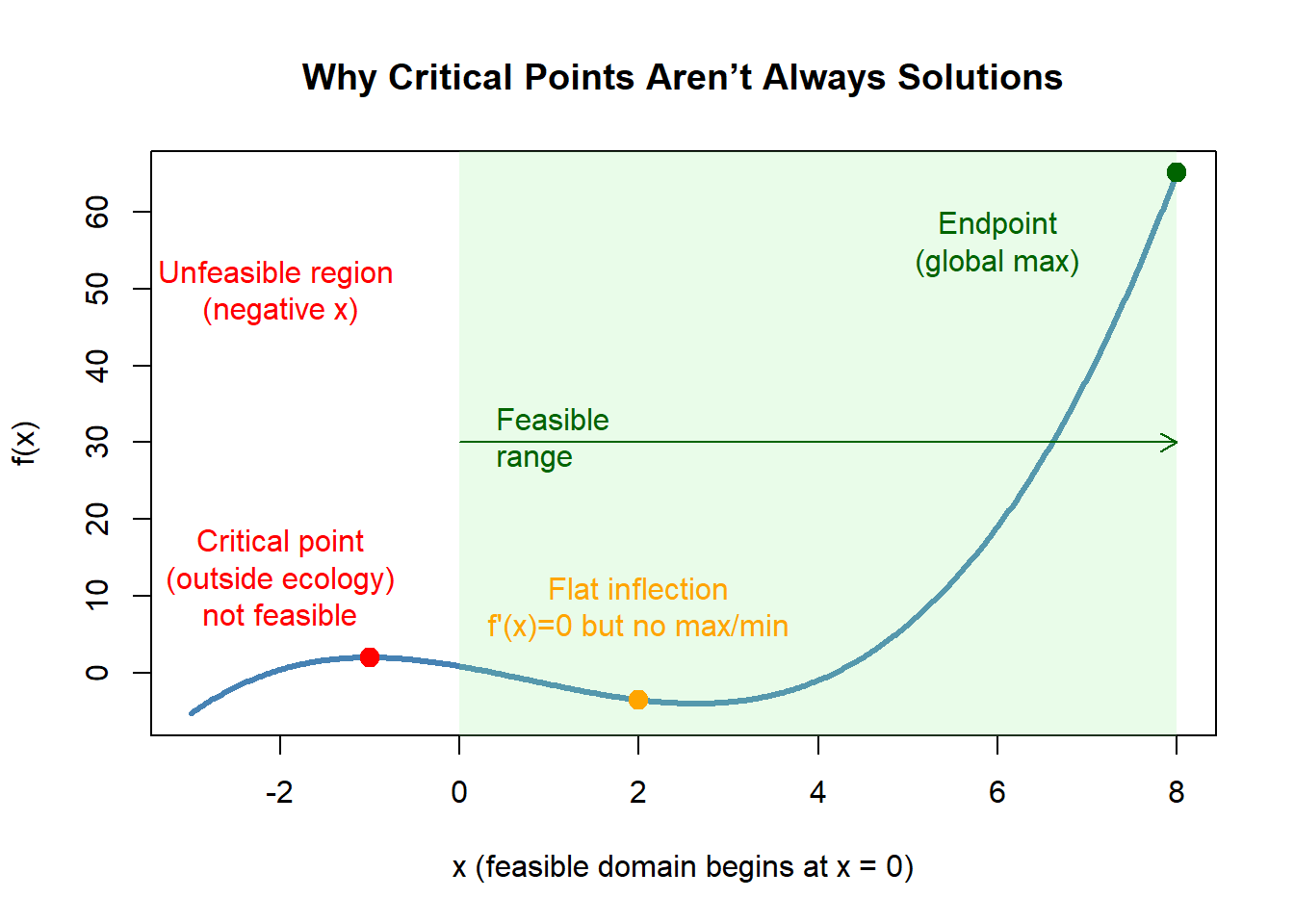
- On your graph:
- Draw a secant line from \(t=0\) to \(t=120\)
- What does that line represent?
- Draw a tangent line at \(t=25\) and \(t=125\)
- What do those lines represent?
- Describe:
- How the slope changes over time
- Whether the graph is concave up or down
18.Below is an image of g forcing testing that measured the actual g-forces felt by astronauts during the first 10mins of a mission.
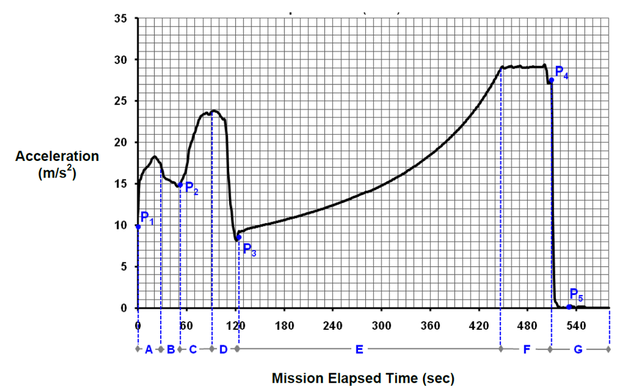 Describe:
- Describe the concavity of this plot/
Sketch the derivative of this graph. Challenge:
- Can you take a guess at which might be happening at P2 and P3?
- At P5, why does the acceleration the astronauts feel drop to zero? Any idea why?
Below is the height above the earth’s surface of the re-entry vehicle over time.
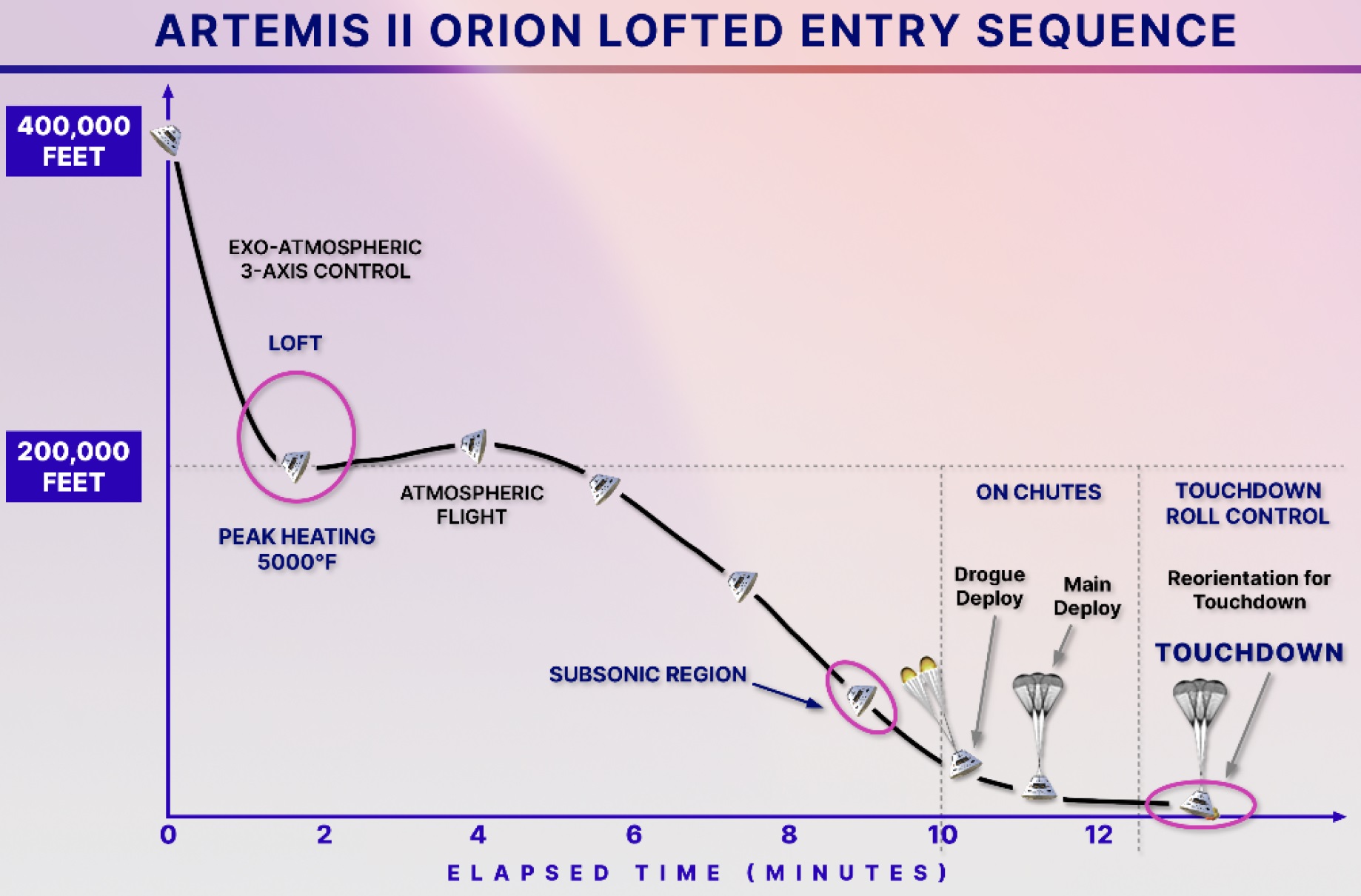 - Sketch the derivative of this function
- What does this derivative represent?
-Sketch the second derivative?
- What does this derivative represent?
- Sketch the derivative of this function
- What does this derivative represent?
-Sketch the second derivative?
- What does this derivative represent?
14.1.9 Part G: Reflection
- In your own words:
- What is the difference between average rate of change and instantaneous rate of change?
Solution
Answer Key: Bonus Applications — Artemis Takeoff
Given
\[ h(t)=0.00333t^2 \]
where \(t\) is in seconds and \(h(t)\) is in kilometers.
Part A: Understanding the Function
1.
\[ h(0)=0 \]
Interpretation: The rocket is on the launch pad at \(t=0\).
2.
\[ h(60)=0.00333(3600)=11.988 \approx 11.99 \text{ km} \]
\[ h(120)=0.00333(14400)=47.952 \approx 47.95 \text{ km} \]
3.
- \(h(t)\): kilometers
- \(t\): seconds
Part B: Average Rate of Change (AROC)
4a.
\[ \frac{11.988-0}{60}=0.1998 \text{ km/s} \]
4b.
\[ \frac{47.952-11.988}{60}=0.5994 \text{ km/s} \]
5.
Represents average velocity.
Since the value increases, the rocket is speeding up.
Part C: Zooming In (Toward Instantaneous Velocity)
6a.
\[ h(61)=12.39093 \]
\[ \frac{12.39093-11.988}{1}=0.40293 \text{ km/s} \]
6b.
\[ h(60.5)=12.1886325 \]
\[ \frac{12.1886325-11.988}{0.5}=0.401265 \text{ km/s} \]
7.
Approaching:
\[ 0.3996 \text{ km/s} \]
Interpretation: instantaneous velocity at \(t=60\).
Part D: Derivative (Velocity Function)
8.
\[ h(t)=0.00333t^2 \]
\[ h(t+h)=0.00333(t+h)^2 \]
\[ =0.00333t^2+0.00666th+0.00333h^2 \]
\[ \frac{h(t+h)-h(t)}{h} =\frac{0.00666th+0.00333h^2}{h} =0.00666t+0.00333h \]
\[ h'(t)=\lim_{h\to 0}(0.00666t+0.00333h) =0.00666t \]
9.
\[ h'(t)=0.00666t \]
10.
\[ h'(60)=0.3996 \text{ km/s} \]
\[ h'(120)=0.7992 \text{ km/s} \]
11.
Represents instantaneous velocity.
Velocity increases over time → rocket is accelerating.
Part E: Acceleration (Second Derivative)
12.
\[ h'(t)=0.00666t \]
\[ h'(t+h)=0.00666t+0.00666h \]
\[ \frac{h'(t+h)-h'(t)}{h} =\frac{0.00666h}{h}=0.00666 \]
\[ h''(t)=0.00666 \]
13.
\[ h''(t)=0.00666 \]
14.
Represents acceleration.
15.
Acceleration is constant.
Part F: Graphical Thinking
16.
- Secant line → average velocity over the interval
- Tangent line → instantaneous velocity at a point
\[ h'(25)=0.1665 \text{ km/s} \]
\[ h'(125)=0.8325 \text{ km/s} \]
17.
- Slope increases over time
- Graph is concave up
18. G-force graph
- Concavity changes throughout
- Derivative represents rate of change of acceleration (jerk)
P2/P3: likely staging or thrust changes
P5: astronauts experience weightlessness (free fall)
19. Re-entry graph
- First derivative → velocity (negative during descent)
- Second derivative → acceleration
Part G: Reflection
20.
- Average rate of change = change over an interval
- Instantaneous rate of change = rate at a single point
In this context:
- AROC = average velocity
- IROC = instantaneous velocity