Test1 Review Material
Below are resources to help you practice and prepare for the tests in this course Test 1 will cover the material covered in Chapter 3 of this textbook.
Multiple Choice
A. Limits and Continuity
1. Which statement is sufficient to conclude that \(\lim_{x\to a} f(x)\) exists?
A. \(f(a)\) is defined
B. \(\lim_{x\to a^-} f(x)\) and \(\lim_{x\to a^+} f(x)\) both exist and are equal
C. \(f(a)=0\)
D. \(f\) is differentiable at \(x=a\)
Hint
A two-sided limit depends on what happens from both sides of \(a\), not just on the function value at \(a\).Answer with justification
Answer: B
A two-sided limit exists when the left-hand and right-hand limits both exist and are equal.- A is not enough because a function can be defined at \(a\) even when the limit does not exist.
- C is irrelevant.
- D is stronger than needed; differentiability implies continuity, but a limit can exist even if the function is not differentiable.
2. Evaluate \(\lim_{x\to 3}\dfrac{x^2-9}{x-3}\).
A. \(0\)
B. \(3\)
C. \(6\)
D. Does not exist
Hint
Factor the numerator before substituting.Answer with justification
Answer: C
\[ \frac{x^2-9}{x-3}=\frac{(x-3)(x+3)}{x-3}=x+3 \quad (x\ne 3) \]
So,
\[ \lim_{x\to 3}\frac{x^2-9}{x-3}=\lim_{x\to 3}(x+3)=6 \]
A common mistake is plugging in \(x=3\) too early and getting \(0/0\), which is indeterminate, not the final answer.3. A function \(f\) satisfies \(\lim_{x\to 2} f(x)=4\), but \(f(2)=10\). Which statement is true?
A. \(f\) is continuous at \(x=2\)
B. \(f\) is differentiable at \(x=2\)
C. \(f\) is not continuous at \(x=2\)
D. The limit does not exist
Hint
Compare the function value to the limit.Answer with justification
Answer: C
A function is continuous at \(x=2\) only if:
\[ \lim_{x\to 2}f(x)=f(2) \]
Here,
\[ \lim_{x\to 2}f(x)=4 \ne 10=f(2) \]
So the function is not continuous at \(x=2\). If a function is not continuous, it also cannot be differentiable there.4. For the piecewise function
\[ f(x)= \begin{cases} 2x+3,& x<1\\ 5,& x=1\\ x^2+1,& x>1 \end{cases} \] which statement is correct?
A. \(f\) is continuous and differentiable at \(x=1\)
B. \(f\) is continuous but not differentiable at \(x=1\)
C. \(f\) is not continuous at \(x=1\)
D. The left-hand and right-hand limits at \(x=1\) are both 5
Hint
Compute the left-hand limit and the right-hand limit separately at \(x=1\).Answer with justification
Answer: C
Left-hand limit:
\[ \lim_{x\to 1^-}(2x+3)=5 \]
Right-hand limit:
\[ \lim_{x\to 1^+}(x^2+1)=2 \]
Since the one-sided limits are not equal, the two-sided limit does not exist. Therefore, \(f\) is not continuous at \(x=1\), and therefore cannot be differentiable there either.B. The Limit Definition of the Derivative
5. The derivative
\[ f'(x)=\lim_{h\to 0}\frac{f(x+h)-f(x)}{h} \] represents which idea?
A. Average rate of change over an interval
B. Instantaneous rate of change at a point
C. The value of the function at \(x\)
D. The second derivative
Hint
The limit shrinks the interval width \(h\) toward zero.Answer with justification
Answer: B
The derivative is the instantaneous rate of change at a point.- A describes the difference quotient before taking the limit.
- C is just \(f(x)\).
- D refers to the derivative of the derivative.
6. Using the limit definition, what is \(f'(x)\) for \(f(x)=x^2+2x\)?
A. \(x+2\)
B. \(2x+2\)
C. \(2x\)
D. \(x^2\)
Hint
Expand \(f(x+h)\), subtract \(f(x)\), divide by \(h\), then take the limit.Answer with justification
Answer: B
Using the limit definition,
\[ f(x+h)=(x+h)^2+2(x+h)=x^2+2xh+h^2+2x+2h \]
Then:
\[ f(x+h)-f(x)=2xh+h^2+2h \]
Divide by \(h\):
\[ \frac{f(x+h)-f(x)}{h}=2x+h+2 \]
Take the limit as \(h\to 0\):
\[ f'(x)=2x+2 \]
A common mistake is forgetting the derivative of the \(2x\) term.7. Using the limit definition, what is \(f'(x)\) for \(f(x)=\frac{1}{x}\)?
A. \(\frac{1}{x^2}\)
B. \(-\frac{1}{x}\)
C. \(-\frac{1}{x^2}\)
D. \(\frac{1}{x}\)
Hint
Combine the fractions in \(f(x+h)-f(x)\) before dividing by \(h\).Answer with justification
Answer: C
Using the definition:
\[ \frac{\frac{1}{x+h}-\frac{1}{x}}{h} = \frac{\frac{x-(x+h)}{x(x+h)}}{h} = \frac{-h}{h\,x(x+h)} = -\frac{1}{x(x+h)} \]
Taking the limit \(h\to 0\):
\[ f'(x)=-\frac{1}{x^2} \]
The negative sign is a common place for mistakes.8. What is \(f'(a)\) for \(f(x)=x^2+2x\)?
A. \(a^2+2\)
B. \(2a+2\)
C. \(2a\)
D. \(a+2\)
Hint
First find the derivative formula, then evaluate it at \(x=a\).Answer with justification
Answer: B
Since
\[ f'(x)=2x+2 \]
then
\[ f'(a)=2a+2 \]
A common misconception is to substitute \(a\) into the original function instead of the derivative.C. Average and Instantaneous Rate of Change
9. Let \(s(t)=2t^2+5t\). What is the average velocity on \([0,4]\)?
A. \(7\)
B. \(13\)
C. \(17\)
D. \(52\)
Hint
Use \(\dfrac{s(4)-s(0)}{4-0}\), not just \(s(4)\).Answer with justification
Answer: B
\[ s(4)=2(4)^2+5(4)=32+20=52 \]
\[ s(0)=0 \]
Average velocity:
\[ \frac{52-0}{4}=13 \]
Choice D is the position at \(t=4\), not the average velocity.10. Let \(s(t)=2t^2+5t\). What is the instantaneous velocity at \(t=3\)?
A. \(13\)
B. \(17\)
C. \(23\)
D. \(33\)
Hint
Instantaneous velocity is the derivative of position.Answer with justification
Answer: B
\[ s'(t)=4t+5 \]
So,
\[ s'(3)=4(3)+5=17 \]
A common confusion is mixing this with the average velocity from another interval.11. A river monitoring station records the height of the water surface, \(h(t)\), over time during a storm. Which statement best compares the average rate of change and the instantaneous rate of change of water level?
A. They are always equal
B. Average rate of change uses two times over an interval; instantaneous rate of change uses a limit at one time
C. Instantaneous rate of change is always larger
D. Average rate of change only applies when the water level changes at a constant rate
Hint
Think about the difference between measuring how much the water level changes over several hours versus how fast it is changing at one exact moment.Answer with justification
Answer: B
The average rate of change of water level over a time interval is:
\[ \frac{h(t+h)-h(t)}{h} \]
This tells you how much the water level changed on average over that period.
The instantaneous rate of change is:
\[ \lim_{h\to0}\frac{h(t+h)-h(t)}{h} \]
This tells you how fast the water level is rising or falling at one exact moment.
They are not always equal, and average rate of change does not require the water level to change at a constant rate.12. For \(f(x)=x^3-2x+1\), what is \(f'(x)\)?
A. \(3x^2-2\)
B. \(x^2-2\)
C. \(3x^2+1\)
D. \(3x-2\)
Hint
Differentiate each term separately.Answer with justification
Answer: A
\[ \frac{d}{dx}(x^3)=3x^2,\qquad \frac{d}{dx}(-2x)=-2,\qquad \frac{d}{dx}(1)=0 \]
So,
\[ f'(x)=3x^2-2 \]
Choice D is a common power-rule mistake.13. For \(f(x)=x^3-2x+1\), where does \(f'(x)=0\)?
A. \(x=\pm \sqrt{2}\)
B. \(x=\pm \sqrt{\frac{2}{3}}\)
C. \(x=\pm \frac{2}{3}\)
D. \(x=\frac{2}{3}\)
Hint
Set \(3x^2-2=0\) and solve carefully.Answer with justification
Answer: B
\[ 3x^2-2=0 \]
\[ 3x^2=2 \]
\[ x^2=\frac{2}{3} \]
\[ x=\pm \sqrt{\frac{2}{3}} \]
Choice A forgets the coefficient 3.D. Graphical Reasoning
14. If a graph has a sharp corner at \(x=2\), then:
A. \(f(2)\) does not exist
B. \(f'(2)=0\)
C. \(f'(2)\) does not exist
D. The limit at \(x=2\) does not exist
Hint
A corner can occur on a continuous graph.Answer with justification
Answer: C
At a sharp corner, the left-hand and right-hand slopes are different, so there is no single derivative value. The function can still be continuous there, so A and D are not necessarily true.15. If \(f'(x)>0\) on an interval, what does this mean about \(f(x)\) on that interval?
A. \(f(x)\) is decreasing
B. \(f(x)\) is increasing
C. \(f(x)\) is concave up
D. \(f(x)\) has a local minimum everywhere
Hint
The sign of the first derivative tells you about increasing versus decreasing.Answer with justification
Answer: B
If \(f'(x)>0\), then the slope is positive, so \(f(x)\) is increasing on that interval. Concavity is determined by \(f''(x)\), not \(f'(x)\).16. If \(f'(x)\) changes from positive to negative at \(x=a\), then \(f(x)\) has a:
A. Local minimum at \(x=a\)
B. Local maximum at \(x=a\)
C. Point of inflection at \(x=a\)
D. Vertical tangent at \(x=a\)
Hint
Think about the graph rising before \(a\) and falling after \(a\).Answer with justification
Answer: B
If \(f'(x)\) changes from positive to negative, then the function changes from increasing to decreasing, which means \(f(x)\) has a local maximum at \(x=a\).E. Second Derivatives and Motion
17. For \(f(x)=x^3-3x^2+2\), what is \(f''(x)\)?
A. \(3x^2-6x\)
B. \(6x-6\)
C. \(6x\)
D. \(3x-6\)
Hint
Differentiate twice: once for \(f'(x)\), then again.Answer with justification
Answer: B
First derivative:
\[ f'(x)=3x^2-6x \]
Second derivative:
\[ f''(x)=6x-6 \]
Choice A is the first derivative, not the second.Short Answer
Limits and Continuity
1. Explain how to test if a limit exists at a point on a function.
Solution
To test whether \(\lim_{x \to a} f(x)\) exists:
- Evaluate the left-hand limit: \(\lim_{x \to a^-} f(x)\)
- Evaluate the right-hand limit: \(\lim_{x \to a^+} f(x)\)
The limit exists if:
- Both one-sided limits exist, and
- They are equal
If they are not equal, the limit does not exist.
Graphically: - The function must approach the same value from both sides of \(x=a\).2. Explain the conditions under which a limit can fail to exist.
Solution
A limit can fail to exist if:
- The left-hand and right-hand limits are not equal (jump discontinuity)
- The function increases or decreases without bound (infinite limit)
- The function oscillates and does not approach a single value
3. Give an example of a function where the limit exists but the function is not continuous at that point.
Solution
Example: \[ f(x)= \begin{cases} x^2, & x \ne 2 \\ 10, & x = 2 \end{cases} \]
\[ \lim_{x \to 2} f(x)=4 \]
But \(f(2)=10\), so the function is not continuous.
Continuity fails because:
- The limit exists
- The function is defined
- But the values are not equal
Rates of Change and Tangent Lines
6. Explain the relationship between a secant line and an average rate of change.
Solution
A secant line connects two points on a curve.
Its slope is: \[ \frac{f(b)-f(a)}{b-a} \]
This represents the average rate of change over an interval.
It tells how much the function changes between two points.8. Compare secant and tangent lines.
Solution
- Secant line → average rate of change over an interval
- Tangent line → instantaneous rate of change at a point
Differentiability and Smoothness
11. State the conditions required for a function to be differentiable at a point.
Solution
A function is differentiable at \(x=a\) if:
It is continuous at that point
It is smooth, meaning:
- No corners
- No cusps
- No vertical tangents
- No corners
Additionally:
- Left-hand and right-hand derivatives must exist and be equal
12. Give an example of a function with a corner or cusp, and explain why the derivative does not exist.
Solution
Example: \[ f(x)=|x| \]
At \(x=0\):
- Left-hand slope = -1
- Right-hand slope = +1
Since they are not equal, the derivative does not exist.
There is no single tangent line at that point.13. Identify two scenarios where a function is not differentiable.
Solution
Corner or cusp
Example: \(f(x)=|x|\)Discontinuity
Example: jump function
14. How can a function be continuous but not differentiable?
Solution
A function can be continuous but have a corner or cusp.
Example: \[ f(x)=|x| \]
- Continuous at \(x=0\)
- But slopes from left and right differ
Derivatives and Interpretation
17. Write the limit definition of the derivative.
Solution
\[ f'(x)=\lim_{h \to 0}\frac{f(x+h)-f(x)}{h} \]
It represents the instantaneous rate of change.18. What does it mean when \(f'(x)=0\)?
Solution
It means:
- The slope of the tangent line is zero
- The tangent line is horizontal
These are critical points, which may be:
- Local maxima
- Local minima
- Or neither
Problems
Problem 1
Let \(f(x)=10x^{2}+e^{x}\).
- Find the average velocity on the interval \([2,6]\).
- Estimate, using the limit definition of the derivative, the instantaneous velocity at \(x=4\).
Solution
For \(f(x)=10x^2+e^x\):
- Average velocity on \([2,6]\):
\[ \text{Average velocity}=\frac{f(6)-f(2)}{6-2} \]
First compute the function values:
\[ f(6)=10(6)^2+e^6=360+e^6 \]
\[ f(2)=10(2)^2+e^2=40+e^2 \]
So,
\[ \frac{f(6)-f(2)}{4} =\frac{(360+e^6)-(40+e^2)}{4} =\frac{320+e^6-e^2}{4} \]
\[ \boxed{\text{Average velocity}=80+\frac{e^6-e^2}{4}} \]
- Instantaneous velocity at \(x=4\) using the limit definition:
Use
\[ f'(4)=\lim_{h\to 0}\frac{f(4+h)-f(4)}{h} \]
Compute each part:
\[ f(4+h)=10(4+h)^2+e^{4+h} \]
Expand:
\[ 10(4+h)^2=10(16+8h+h^2)=160+80h+10h^2 \]
So,
\[ f(4+h)=160+80h+10h^2+e^{4+h} \]
Also,
\[ f(4)=10(4)^2+e^4=160+e^4 \]
Now form the difference quotient:
\[ \frac{f(4+h)-f(4)}{h} = \frac{160+80h+10h^2+e^{4+h}-(160+e^4)}{h} \]
\[ = \frac{80h+10h^2+e^{4+h}-e^4}{h} \]
\[ = 80+10h+\frac{e^{4+h}-e^4}{h} \]
At this point you can select a small h to approximate the solution.
Let \(h\to 0.001\):
\[ f'(4) \approx 134.6 \]
Problem 2
Using the limit definition of the derivative, let \(f(x)=x^{2}-4x\).
- Find an expression for \(f'(x)\).
- Find the derivative at \(x=3\).
- Find the equation of the tangent line at \(x=3\).
- Using \(f'(x)\), determine where the rate of change of \(f(x)\) is zero.
- Explain how you would adapt the limit definition of a first derivative to find the second derivative.
(Do not actually compute \(f''(x)\).)
- In words, what does the second derivative mean?
Solution
For \(f(x)=x^2-4x\):
- Find \(f'(x)\) using the limit definition:
\[ f'(x)=\lim_{h\to 0}\frac{f(x+h)-f(x)}{h} \]
First compute:
\[ f(x+h)=(x+h)^2-4(x+h) \]
\[ = x^2+2xh+h^2-4x-4h \]
Now subtract \(f(x)=x^2-4x\):
\[ f(x+h)-f(x)=x^2+2xh+h^2-4x-4h-(x^2-4x) \]
\[ =2xh+h^2-4h \]
So,
\[ \frac{f(x+h)-f(x)}{h}=\frac{2xh+h^2-4h}{h}=2x+h-4 \]
Take the limit:
\[ f'(x)=\lim_{h\to 0}(2x+h-4)=2x-4 \]
\[ \boxed{f'(x)=2x-4} \]
- Find the derivative at \(x=3\):
\[ f'(3)=2(3)-4=2 \]
\[ \boxed{f'(3)=2} \]
- Find the equation of the tangent line at \(x=3\):
First find the point on the curve:
\[ f(3)=3^2-4(3)=9-12=-3 \]
So the point is \((3,-3)\), and the slope is \(2\).
Use point-slope form:
\[ y-(-3)=2(x-3) \]
\[ y+3=2x-6 \]
\[ y=2x-9 \]
\[ \boxed{y=2x-9} \]
- Where is the rate of change zero?
Set \(f'(x)=0\):
\[ 2x-4=0 \]
\[ 2x=4 \]
\[ x=2 \]
So the rate of change is zero at
\[ \boxed{x=2} \]
- How to adapt the limit definition to find the second derivative:
The second derivative is the derivative of the first derivative.
So once you have \(f'(x)\), you apply the same limit-definition idea again:
\[ f''(x)=\lim_{h\to 0}\frac{f'(x+h)-f'(x)}{h} \]
This is the same structure as the first derivative, but now it is applied to \(f'(x)\) instead of \(f(x)\).
- Meaning of the second derivative:
The second derivative tells how the rate of change is changing.
In words:
- It measures how the slope of the function changes
- It helps describe concavity
- It shows whether the graph is bending upward or downward
Problem 3
Let \(g(x) = 7x^2\).
- Compute the average rate of change on the interval \([1,4]\).
- Estimate the instantaneous rate of change at \(x = 2\) using the limit definition.
Solution
For \(g(x)=7x^2\):
- Average rate of change on \([1,4]\):
\[ \frac{g(4)-g(1)}{4-1} \]
Compute the function values:
\[ g(4)=7(4)^2=7(16)=112 \]
\[ g(1)=7(1)^2=7 \]
So,
\[ \frac{112-7}{3}=\frac{105}{3}=35 \]
\[ \boxed{35} \]
- Instantaneous rate of change at \(x=2\) using the limit definition:
\[ g'(2)=\lim_{h\to 0}\frac{g(2+h)-g(2)}{h} \]
Compute:
\[ g(2+h)=7(2+h)^2 \]
\[ =7(4+4h+h^2)=28+28h+7h^2 \]
Also,
\[ g(2)=7(2)^2=28 \]
Now form the difference quotient:
\[ \frac{g(2+h)-g(2)}{h} = \frac{(28+28h+7h^2)-28}{h} \]
\[ =\frac{28h+7h^2}{h}=28+7h \]
Take the limit:
\[ g'(2)=\lim_{h\to 0}(28+7h)=28 \]
\[ \boxed{28} \]
Problem 4
Let \(f(x) = x^2 + 2x\). Using the limit definition:
- Derive the formula for \(f'(x)\).
- Calculate the derivative at \(x = -1\).
- Write the equation of the tangent line to \(f(x)\) at \(x = -1\).
- Briefly describe how the limit definition could be used to find the second derivative.
Find an expression for \(f''(x)\).
- Explain what the second derivative tells you about the behavior of the function.
Solution
For \(f(x)=x^2+2x\):
- Derive \(f'(x)\) using the limit definition:
\[ f'(x)=\lim_{h\to 0}\frac{f(x+h)-f(x)}{h} \]
First compute:
\[ f(x+h)=(x+h)^2+2(x+h) \]
\[ = x^2+2xh+h^2+2x+2h \]
Now subtract \(f(x)=x^2+2x\):
\[ f(x+h)-f(x)=x^2+2xh+h^2+2x+2h-(x^2+2x) \]
\[ =2xh+h^2+2h \]
So,
\[ \frac{f(x+h)-f(x)}{h}=\frac{2xh+h^2+2h}{h}=2x+h+2 \]
Take the limit:
\[ f'(x)=\lim_{h\to 0}(2x+h+2)=2x+2 \]
\[ \boxed{f'(x)=2x+2} \]
- Derivative at \(x=-1\):
\[ f'(-1)=2(-1)+2=0 \]
\[ \boxed{f'(-1)=0} \]
- Equation of the tangent line at \(x=-1\):
First find the point:
\[ f(-1)=(-1)^2+2(-1)=1-2=-1 \]
So the point is \((-1,-1)\), and the slope is \(0\).
Use point-slope form:
\[ y-(-1)=0(x-(-1)) \]
\[ y+1=0 \]
\[ y=-1 \]
\[ \boxed{y=-1} \]
- How to use the limit definition to find the second derivative, and find \(f''(x)\):
The second derivative is the derivative of \(f'(x)\), so use
\[ f''(x)=\lim_{h\to 0}\frac{f'(x+h)-f'(x)}{h} \]
Since \(f'(x)=2x+2\),
\[ f'(x+h)=2(x+h)+2=2x+2h+2 \]
Then
\[ \frac{f'(x+h)-f'(x)}{h} = \frac{(2x+2h+2)-(2x+2)}{h} \]
\[ =\frac{2h}{h}=2 \]
So,
\[ f''(x)=\lim_{h\to 0}2=2 \]
\[ \boxed{f''(x)=2} \]
- What the second derivative tells you:
The second derivative describes how the slope is changing.
Since
\[ f''(x)=2>0 \]
the graph is concave up everywhere.
This means:
- Slopes are increasing
- The graph bends upward
- Any critical point would be a local minimum
Problem 5
Let \(s(t) = 16t^2 + e^t\).
- Find the average velocity on the interval \([1, 10]\).
- Estimate the instantaneous velocity at \(t = 5\).
Solution
For \(s(t)=16t^2+e^t\):
- Average velocity on \([1,10]\):
\[ \text{Average velocity}=\frac{s(10)-s(1)}{10-1} \]
Compute the function values:
\[ s(10)=16(10)^2+e^{10}=1600+e^{10} \]
\[ s(1)=16(1)^2+e=e^1+16=16+e \]
So,
\[ \frac{s(10)-s(1)}{9} = \frac{(1600+e^{10})-(16+e)}{9} \]
\[ = \frac{1584+e^{10}-e}{9} \]
Thus, the average velocity is
\[ \boxed{\frac{1584+e^{10}-e}{9}} \]
- Instantaneous velocity at \(t=5\):
Using the limit definition,
\[ s'(5)=\lim_{h\to 0}\frac{s(5+h)-s(5)}{h} \]
First compute:
\[ s(5+h)=16(5+h)^2+e^{5+h} \]
Expand the quadratic term:
\[ 16(5+h)^2=16(25+10h+h^2)=400+160h+16h^2 \]
So,
\[ s(5+h)=400+160h+16h^2+e^{5+h} \]
Also,
\[ s(5)=16(5)^2+e^5=400+e^5 \]
Now form the difference quotient:
\[ \frac{s(5+h)-s(5)}{h} = \frac{400+160h+16h^2+e^{5+h}-(400+e^5)}{h} \]
\[ = \frac{160h+16h^2+e^{5+h}-e^5}{h} \]
\[ = 160+16h+\frac{e^{5+h}-e^5}{h} \]
Taking the limit as \(h\to 0\):
\[ s'(5)=160+e^5 \]
So the instantaneous velocity at \(t=5\) is
\[ \boxed{160+e^5} \]
Problem 6
Using the limit definition of the derivative, let \(f(x) = x^2 + 3x\).
- Find an expression for \(f'(x)\).
- Find the derivative at \(f'(2)\).
- Find the equation of the tangent line at \(x = 2\).
- Using \(f'(x)\), determine where the rate of change of \(f(x)\) is zero.
Solution
For \(f(x)=x^2+3x\):
- Find \(f'(x)\) using the limit definition:
\[ f'(x)=\lim_{h\to 0}\frac{f(x+h)-f(x)}{h} \]
First compute:
\[ f(x+h)=(x+h)^2+3(x+h) \]
\[ = x^2+2xh+h^2+3x+3h \]
Now subtract \(f(x)=x^2+3x\):
\[ f(x+h)-f(x)=x^2+2xh+h^2+3x+3h-(x^2+3x) \]
\[ =2xh+h^2+3h \]
So,
\[ \frac{f(x+h)-f(x)}{h} = \frac{2xh+h^2+3h}{h} =2x+h+3 \]
Take the limit:
\[ f'(x)=\lim_{h\to 0}(2x+h+3)=2x+3 \]
\[ \boxed{f'(x)=2x+3} \]
- Find \(f'(2)\):
\[ f'(2)=2(2)+3=7 \]
\[ \boxed{f'(2)=7} \]
- Find the equation of the tangent line at \(x=2\):
First find the point on the graph:
\[ f(2)=2^2+3(2)=4+6=10 \]
So the point is \((2,10)\), and the slope is \(7\).
Use point-slope form:
\[ y-10=7(x-2) \]
\[ y-10=7x-14 \]
\[ y=7x-4 \]
\[ \boxed{y=7x-4} \]
- Where is the rate of change zero?
Set \(f'(x)=0\):
\[ 2x+3=0 \]
\[ 2x=-3 \]
\[ x=-\frac{3}{2} \]
So the rate of change is zero at
\[ \boxed{x=-\frac{3}{2}} \]
Sketching Practice
Sketch 1
The graph of a function \(h(x)\) is shown below. Use it to answer the questions.
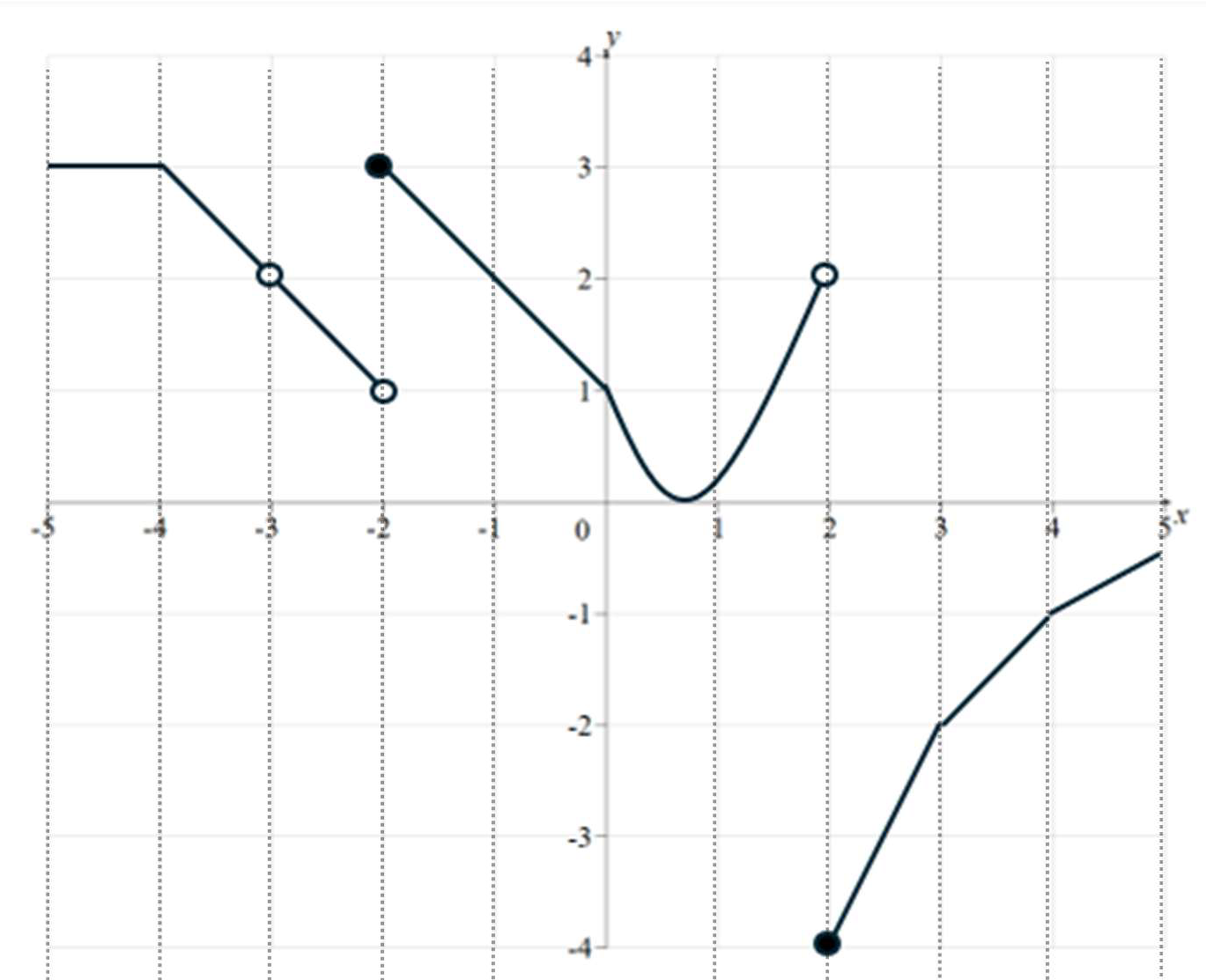
- (2 pts) Identify all points where \(h(x)\) has no limit. Explain why.
- (2 pts) Identify all points where \(h(x)\) is not continuous. Explain why.
- (2 pts) Identify all points where \(h(x)\) is not differentiable. Explain why.
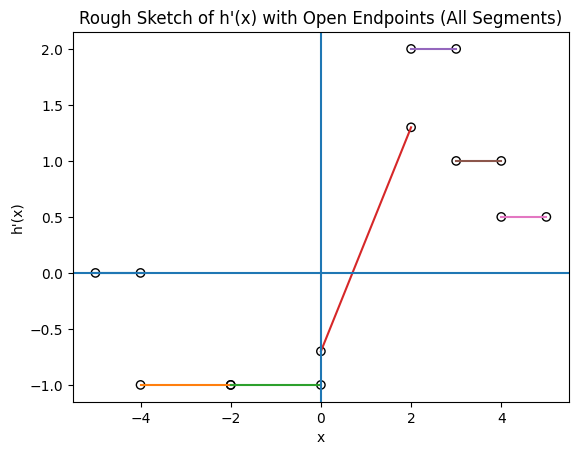
- (4 pts) Roughly sketch the derivative \(h'(x)\).
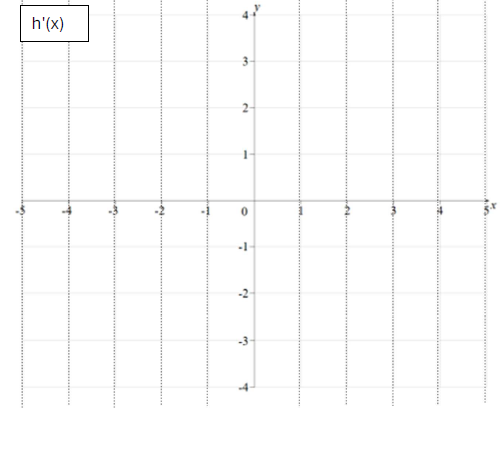
Solution
- No limit at x= -2 and 2
- Not continuous at x= -3,-2 and 2
- Not smooth at -4, -3,-2,0,2,3,4
- Below is a sketch of the solution - remember things don’t have to be perfect, relative differences in slope, key features like zeros, and point where the function have no derivative are the most important parts to capture
Sketch 2
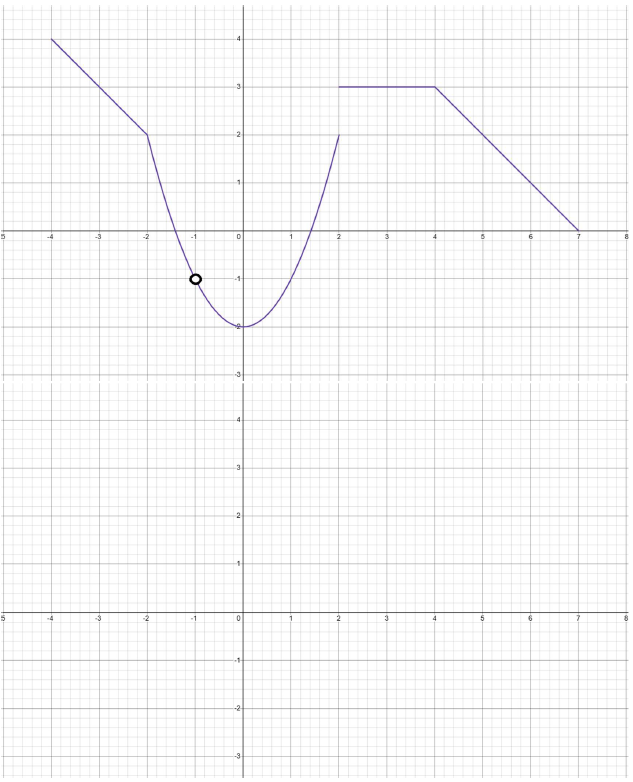
The graph of the function \(r(x)\) is shown below.
- (2 pts) List all \(x\)-values where \(r(x)\) has no limit. Explain.
- (2 pts) List all points where \(r(x)\) is not continuous. Explain why.
- (2 pts) Identify all points where \(r(x)\) is not differentiable. Provide reasons.
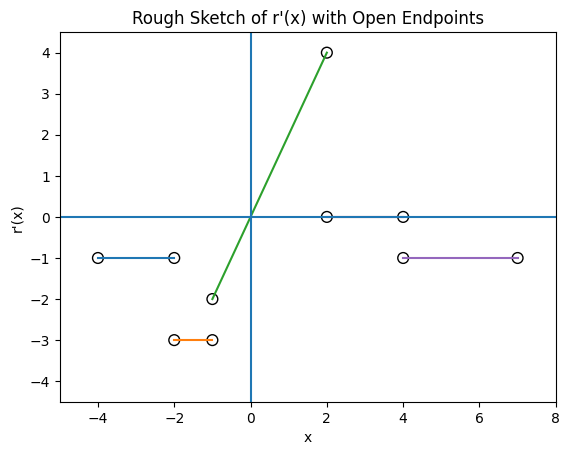
- (4 pts) Sketch a graph of the derivative \(r'(x)\), based on the shape of \(r(x)\).
Solution
- No limit at x= 2
- Not continuous at x= -1 and 2
- Not differentialble at x= -2, -1, 2 and 4
- Below is a sketch of the solution - remember things don’t have to be perfect, relative differences in slope, key features like zeros, and point where the function have no derivative are the most important parts to capture
Sketch 3
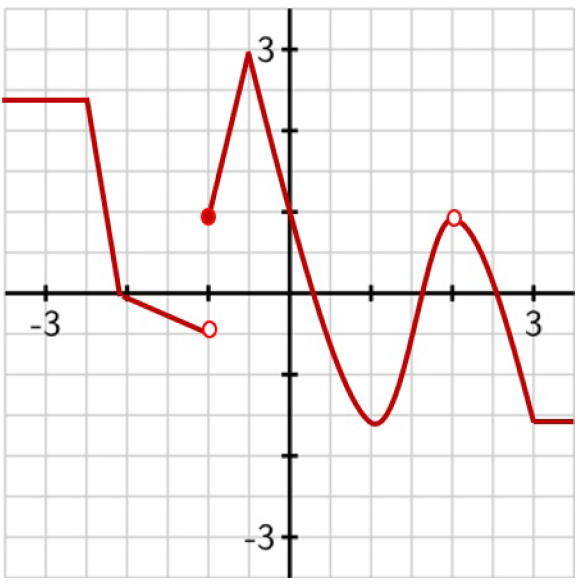
The graph of a function \(g(x)\) is shown below. Use it to answer the following questions.
- (2 pts) Identify all points where \(g(x)\) has no limit. Explain why.
- (2 pts) Identify all points where \(g(x)\) is not continuous. Explain why.
- (2 pts) Identify all points where \(g(x)\) is not differentiable. Explain why.
- (4 pts) Roughly sketch the derivative \(g'(x)\).
Solution
- No limit at x= -1
- Not continuous at x= -1 and 2
- Not differentialble at x= -2, -1, 2 and 3
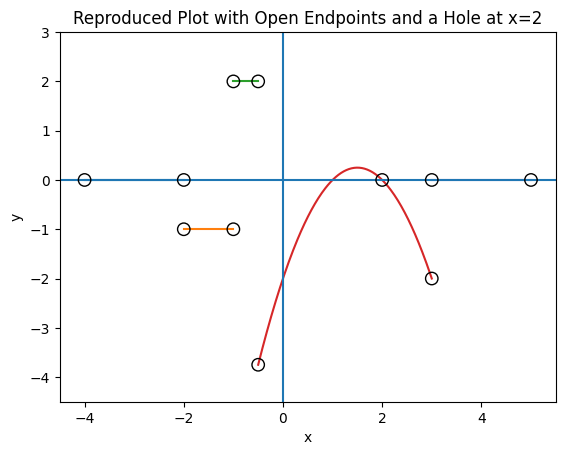
- Below is a sketch of the solution - remember things don’t have to be perfect, relative differences in slope, key features like zeros, and point where the function have no derivative are the most important parts to capture
More Practice - These are harder
A. Limits and Continuity
1. Evaluate the following limits.
- \(\lim_{x \to 3} \frac{x^2 - 9}{x - 3}\)
- \(\lim_{x \to 0} \frac{\sin(5x)}{x}\)
- \(\lim_{x \to 2^-} \frac{|x - 2|}{x - 2}\)
Solution
- Factor the numerator:
\[ \frac{x^2-9}{x-3}=\frac{(x-3)(x+3)}{x-3}=x+3 \quad \text{for } x\ne 3 \]
So,
\[ \lim_{x\to 3}\frac{x^2-9}{x-3}=\lim_{x\to 3}(x+3)=6 \]
\[ \boxed{6} \]
- Rewrite the expression:
\[ \frac{\sin(5x)}{x}=5\cdot \frac{\sin(5x)}{5x} \]
As \(x\to 0\), we use the standard limit \(\lim_{u\to 0}\frac{\sin u}{u}=1\). Therefore,
\[ \lim_{x\to 0}\frac{\sin(5x)}{x}=5 \]
\[ \boxed{5} \]
- For \(x<2\), we have \(x-2<0\), so
\[ |x-2|=-(x-2) \]
Thus,
\[ \frac{|x-2|}{x-2}=\frac{-(x-2)}{x-2}=-1 \]
So,
\[ \lim_{x\to 2^-}\frac{|x-2|}{x-2}=-1 \]
\[ \boxed{-1} \]
2. For the piecewise function
\[ f(x) = \begin{cases} 2x + 3, & x < 1 \\ 5, & x = 1 \\ x^2 + 1, & x > 1 \end{cases} \]
- Determine if \(f(x)\) is continuous at \(x = 1\).
- Determine if \(f(x)\) is differentiable at \(x = 1\).
Solution
To test continuity at \(x=1\), we check:
- Is \(f(1)\) defined?
- Does \(\lim_{x\to 1} f(x)\) exist?
- Is the limit equal to \(f(1)\)?
First,
\[ f(1)=5 \]
Now compute the one-sided limits.
From the left:
\[ \lim_{x\to 1^-}f(x)=\lim_{x\to 1^-}(2x+3)=2(1)+3=5 \]
From the right:
\[ \lim_{x\to 1^+}f(x)=\lim_{x\to 1^+}(x^2+1)=1^2+1=2 \]
Since the left-hand and right-hand limits are not equal, the two-sided limit does not exist.
So:
- \(f(x)\) is not continuous at \(x=1\)
\[ \boxed{\text{\(f\) is not continuous at } x=1} \]
For differentiability:
A function must first be continuous in order to be differentiable. Since \(f\) is not continuous at \(x=1\), it cannot be differentiable there.
\[ \boxed{\text{\(f\) is not differentiable at } x=1} \]
3. Sketch a function that is:
- Continuous everywhere but not differentiable at \(x = 2\).
- Discontinuous but with both left and right limits existing.
Solution
A good example of a function that is continuous everywhere but not differentiable at \(x=2\) is:
\[ f(x)=|x-2| \]
Why: - It is continuous for all \(x\) - At \(x=2\), it has a sharp corner - The left-hand slope is \(-1\) and the right-hand slope is \(+1\), so the derivative does not exist there
A good example of a function that is discontinuous but has both one-sided limits existing is:
\[ g(x)= \begin{cases} x+1, & x<2 \\ 5, & x=2 \\ x+1, & x>2 \end{cases} \]
Why: - As \(x\to 2^-\), \(g(x)\to 3\) - As \(x\to 2^+\), \(g(x)\to 3\) - So both one-sided limits exist and are equal - But \(g(2)=5\), so the function is not continuous at \(x=2\)
A sketch for the first should look like a V-shape centered at \(x=2\).A sketch for the second should look like a straight line with an open circle at \((2,3)\) and a filled dot at \((2,5)\).
B. The Limit Definition of the Derivative
4. Using
\[
f'(x) = \lim_{h \to 0} \frac{f(x+h) - f(x)}{h},
\]
find \(f'(x)\) for:
a. \(f(x) = 3x^2 - 4x + 1\)
b. \(f(x) = \frac{1}{x}\)
c. \(f(x) = \sqrt{x}\)
Solution
- For \(f(x)=3x^2-4x+1\),
\[ f(x+h)=3(x+h)^2-4(x+h)+1 \]
\[ =3(x^2+2xh+h^2)-4x-4h+1 \]
\[ =3x^2+6xh+3h^2-4x-4h+1 \]
Now subtract \(f(x)\):
\[ f(x+h)-f(x)=\left(3x^2+6xh+3h^2-4x-4h+1\right)-(3x^2-4x+1) \]
\[ =6xh+3h^2-4h \]
Divide by \(h\):
\[ \frac{f(x+h)-f(x)}{h}=6x+3h-4 \]
Take the limit as \(h\to 0\):
\[ f'(x)=6x-4 \]
\[ \boxed{f'(x)=6x-4} \]
- For \(f(x)=\frac{1}{x}\),
\[ f(x+h)=\frac{1}{x+h} \]
So,
\[ \frac{f(x+h)-f(x)}{h} = \frac{\frac{1}{x+h}-\frac{1}{x}}{h} \]
Combine the fractions:
\[ \frac{1}{x+h}-\frac{1}{x} = \frac{x-(x+h)}{x(x+h)} = \frac{-h}{x(x+h)} \]
So,
\[ \frac{f(x+h)-f(x)}{h} = \frac{-h}{h\,x(x+h)} = -\frac{1}{x(x+h)} \]
Taking the limit:
\[ f'(x)=\lim_{h\to 0}\left(-\frac{1}{x(x+h)}\right)=-\frac{1}{x^2} \]
\[ \boxed{f'(x)=-\frac{1}{x^2}} \]
- For \(f(x)=\sqrt{x}\),
\[ f(x+h)=\sqrt{x+h} \]
So,
\[ \frac{f(x+h)-f(x)}{h} = \frac{\sqrt{x+h}-\sqrt{x}}{h} \]
Multiply by the conjugate:
\[ \frac{\sqrt{x+h}-\sqrt{x}}{h}\cdot \frac{\sqrt{x+h}+\sqrt{x}}{\sqrt{x+h}+\sqrt{x}} = \frac{(x+h)-x}{h(\sqrt{x+h}+\sqrt{x})} \]
\[ = \frac{h}{h(\sqrt{x+h}+\sqrt{x})} = \frac{1}{\sqrt{x+h}+\sqrt{x}} \]
Now take the limit:
\[ f'(x)=\frac{1}{2\sqrt{x}} \]
\[ \boxed{f'(x)=\frac{1}{2\sqrt{x}}} \]
5. Compute \(f'(a)\) using the definition for \(f(x) = x^2 + 2x\).
Solution
Using the definition,
\[ f'(a)=\lim_{h\to 0}\frac{f(a+h)-f(a)}{h} \]
First compute:
\[ f(a+h)=(a+h)^2+2(a+h) \]
\[ =a^2+2ah+h^2+2a+2h \]
Also,
\[ f(a)=a^2+2a \]
Now subtract:
\[ f(a+h)-f(a)=a^2+2ah+h^2+2a+2h-(a^2+2a) \]
\[ =2ah+h^2+2h \]
Divide by \(h\):
\[ \frac{f(a+h)-f(a)}{h}=2a+h+2 \]
Take the limit:
\[ f'(a)=\lim_{h\to 0}(2a+h+2)=2a+2 \]
\[ \boxed{f'(a)=2a+2} \]
6. Find the equation of the tangent line to \(f(x) = x^2 + 2x\) at \(x = 1\).
Solution
First find the derivative:
\[ f'(x)=2x+2 \]
Now compute the slope at \(x=1\):
\[ f'(1)=2(1)+2=4 \]
Find the point on the curve:
\[ f(1)=1^2+2(1)=3 \]
So the tangent line passes through \((1,3)\) and has slope \(4\).
Use point-slope form:
\[ y-3=4(x-1) \]
Simplify:
\[ y-3=4x-4 \]
\[ y=4x-1 \]
\[ \boxed{y=4x-1} \]
C. Average and Instantaneous Rate of Change
7. Let \(s(t) = 2t^2 + 5t\).
- Find the average velocity from \(t = 0\) to \(t = 4\).
- Find the instantaneous velocity at \(t = 3\).
- Interpret both values.
Solution
- Average velocity from \(t=0\) to \(t=4\):
\[ \frac{s(4)-s(0)}{4-0} \]
Compute:
\[ s(4)=2(4)^2+5(4)=32+20=52 \]
\[ s(0)=0 \]
So,
\[ \frac{52-0}{4}=13 \]
\[ \boxed{13} \]
- Instantaneous velocity is the derivative:
\[ s'(t)=4t+5 \]
At \(t=3\):
\[ s'(3)=4(3)+5=17 \]
\[ \boxed{17} \]
- Interpretation:
- The average velocity of \(13\) means the object’s position changed by an average of 13 units per unit time from \(t=0\) to \(t=4\).
- The instantaneous velocity of \(17\) means that at exactly \(t=3\), the object was moving at 17 units per unit time.
8. A population grows according to \(P(t) = 200e^{0.03t}\).
- Find the average growth rate from \(t = 0\) to \(t = 10\).
- Estimate the instantaneous growth rate at \(t = 5\).
Solution
- Average growth rate from \(t=0\) to \(t=10\):
\[ \frac{P(10)-P(0)}{10-0} \]
Compute:
\[ P(10)=200e^{0.3} \]
\[ P(0)=200e^0=200 \]
So,
\[ \frac{200e^{0.3}-200}{10}=20(e^{0.3}-1) \]
\[ \boxed{20(e^{0.3}-1)} \]
Approximate value:
\[ e^{0.3}\approx 1.3499 \]
\[ 20(1.3499-1)\approx 6.998 \]
\[ \boxed{\text{Average growth rate} \approx 7.0} \]
- Instantaneous growth rate is the derivative:
\[ P'(t)=200(0.03)e^{0.03t}=6e^{0.03t} \]
At \(t=5\):
\[ P'(5)=6e^{0.15} \]
Approximate:
\[ e^{0.15}\approx 1.1618 \]
\[ P'(5)\approx 6(1.1618)\approx 6.97 \]
\[ \boxed{P'(5)=6e^{0.15}\approx 6.97} \]
9. A falling object has position \(s(t) = 100 - 4.9t^2\).
- Find the average velocity from \(t = 0\) to \(t = 2\).
- Find the instantaneous velocity at \(t = 2\).
- Explain what these results mean physically.
Solution
- Average velocity:
\[ \frac{s(2)-s(0)}{2-0} \]
Compute:
\[ s(2)=100-4.9(2)^2=100-19.6=80.4 \]
\[ s(0)=100 \]
So,
\[ \frac{80.4-100}{2}=\frac{-19.6}{2}=-9.8 \]
\[ \boxed{-9.8} \]
- Instantaneous velocity:
\[ s'(t)=-9.8t \]
At \(t=2\):
\[ s'(2)=-19.6 \]
\[ \boxed{-19.6} \]
- Physical meaning:
- The average velocity of \(-9.8\) means the object moved downward at an average rate of 9.8 units per second from \(t=0\) to \(t=2\).
- The instantaneous velocity of \(-19.6\) means that at exactly \(t=2\), the object is moving downward at 19.6 units per second.
- The negative sign indicates downward motion.
D. Tangent Lines and Derivative Applications
10. For \(f(x) = x^3 - 2x + 1\):
- Find \(f'(x)\).
- Determine where \(f'(x) = 0\).
- Classify each as a local max, min, or neither.
Solution
- Differentiate:
\[ f'(x)=3x^2-2 \]
\[ \boxed{f'(x)=3x^2-2} \]
- Set \(f'(x)=0\):
\[ 3x^2-2=0 \]
\[ 3x^2=2 \]
\[ x^2=\frac{2}{3} \]
\[ x=\pm \sqrt{\frac{2}{3}} \]
\[ \boxed{x=\pm \sqrt{\frac{2}{3}}} \]
- Use the second derivative:
\[ f''(x)=6x \]
At \(x=-\sqrt{\tfrac{2}{3}}\), \(f''(x)<0\), so this is a local maximum.
At \(x=\sqrt{\tfrac{2}{3}}\), \(f''(x)>0\), so this is a local minimum.
\[ \boxed{x=-\sqrt{\frac{2}{3}} \text{ is a local max}} \]
\[ \boxed{x=\sqrt{\frac{2}{3}} \text{ is a local min}} \]
11. Write the equation of the tangent line to \(f(x) = \sin(x)\) at \(x = \pi/4\).
Solution
First find the derivative:
\[ f'(x)=\cos(x) \]
Slope at \(x=\pi/4\):
\[ f'\left(\frac{\pi}{4}\right)=\cos\left(\frac{\pi}{4}\right)=\frac{\sqrt{2}}{2} \]
Point on the curve:
\[ f\left(\frac{\pi}{4}\right)=\sin\left(\frac{\pi}{4}\right)=\frac{\sqrt{2}}{2} \]
Use point-slope form:
\[ y-\frac{\sqrt{2}}{2}=\frac{\sqrt{2}}{2}\left(x-\frac{\pi}{4}\right) \]
\[ \boxed{y-\frac{\sqrt{2}}{2}=\frac{\sqrt{2}}{2}\left(x-\frac{\pi}{4}\right)} \]
12. Find the tangent line to \(f(x) = e^x\) at \(x = 0\), and sketch both \(f(x)\) and the tangent.
Solution
First find the derivative:
\[ f'(x)=e^x \]
At \(x=0\):
\[ f'(0)=e^0=1 \]
Point on the graph:
\[ f(0)=e^0=1 \]
Use point-slope form:
\[ y-1=1(x-0) \]
\[ y=x+1 \]
\[ \boxed{y=x+1} \]
For the sketch: - Draw the curve \(y=e^x\), increasing and concave up - Mark the point \((0,1)\) - Draw the line \(y=x+1\), which touches the curve at \((0,1)\)
E. Graphical Reasoning
13. The graph of \(f(x)\) has corners at \(x = -2\) and \(x = 3\).
- At which points is \(f'(x)\) undefined?
- Sketch a rough graph of \(f'(x)\).
Solution
- The derivative is undefined at points where the graph has corners.
So,
\[ \boxed{f'(x) \text{ is undefined at } x=-2 \text{ and } x=3} \]
- A rough sketch of \(f'(x)\) should reflect that:
- There are breaks or undefined points at \(x=-2\) and \(x=3\)
- On intervals where \(f(x)\) is smooth, \(f'(x)\) exists
- The exact shape depends on the slopes of the original graph
14. Given a graph of \(f'(x)\):
- Identify where \(f(x)\) is increasing or decreasing.
- Identify where \(f(x)\) has local maxima or minima.
- Sketch a possible \(f(x)\).
Solution
- \(f(x)\) is:
- Increasing where \(f'(x)>0\)
- Decreasing where \(f'(x)<0\)
- \(f(x)\) has:
- A local maximum where \(f'(x)\) changes from positive to negative
- A local minimum where \(f'(x)\) changes from negative to positive
- To sketch a possible \(f(x)\):
- Make the graph rise where \(f'(x)>0\)
- Make the graph fall where \(f'(x)<0\)
- Put turning points where \(f'(x)=0\) and changes sign
15. A graph of \(g(x)\) has horizontal tangents at \(x = 0\) and \(x = 4\).
What can you infer about the shape of \(g(x)\)?
Solution
A horizontal tangent means:
\[ g'(x)=0 \]
So \(g(x)\) has critical points at \(x=0\) and \(x=4\).
Possible interpretations: - One or both could be local maxima - One or both could be local minima - One could be a flat inflection point
What we can say for sure: - The graph levels off at \(x=0\) and \(x=4\) - The tangent line is horizontal at those points
A sketch might show: - A peak at one of the points - A valley at the other - Or two flat points depending on the behavior of the graphF. Second Derivatives and Motion
16. For \(f(x) = x^3 - 3x^2 + 2\):
- Find \(f'(x)\) and \(f''(x)\).
- Identify where \(f(x)\) is concave up/down.
- Find inflection points.
Solution
- First derivative:
\[ f'(x)=3x^2-6x \]
Second derivative:
\[ f''(x)=6x-6 \]
\[ \boxed{f'(x)=3x^2-6x,\quad f''(x)=6x-6} \]
- Concavity depends on the sign of \(f''(x)\):
\[ f''(x)=6x-6=6(x-1) \]
- If \(x<1\), then \(f''(x)<0\), so \(f\) is concave down
- If \(x>1\), then \(f''(x)>0\), so \(f\) is concave up
- An inflection point occurs where concavity changes.
Set:
\[ f''(x)=0 \Rightarrow 6x-6=0 \Rightarrow x=1 \]
Now find the \(y\)-value:
\[ f(1)=1^3-3(1)^2+2=1-3+2=0 \]
So the inflection point is:
\[ \boxed{(1,0)} \]
17. Suppose \(s(t) = t^3 - 6t^2 + 9t\).
- Find velocity \(v(t)\) and acceleration \(a(t)\).
- Find when the particle is at rest.
- Determine when it’s speeding up or slowing down.
Solution
- Velocity is the derivative of position:
\[ v(t)=s'(t)=3t^2-12t+9 \]
Acceleration is the derivative of velocity:
\[ a(t)=v'(t)=6t-12 \]
\[ \boxed{v(t)=3t^2-12t+9,\quad a(t)=6t-12} \]
- The particle is at rest when \(v(t)=0\):
\[ 3t^2-12t+9=0 \]
Divide by 3:
\[ t^2-4t+3=0 \]
\[ (t-1)(t-3)=0 \]
So the particle is at rest at:
\[ \boxed{t=1 \text{ and } t=3} \]
- A particle is:
- Speeding up when velocity and acceleration have the same sign
- Slowing down when they have opposite signs
Factor velocity:
\[ v(t)=3(t-1)(t-3) \]
Critical times are \(t=1,2,3\), since acceleration is zero at \(t=2\).
Check intervals:
- \(t<1\): \(v>0\), \(a<0\) → slowing down
- \(1<t<2\): \(v<0\), \(a<0\) → speeding up
- \(2<t<3\): \(v<0\), \(a>0\) → slowing down
- \(t>3\): \(v>0\), \(a>0\) → speeding up
So:
\[ \boxed{\text{Speeding up on } (1,2)\cup(3,\infty)} \]
\[ \boxed{\text{Slowing down on } (-\infty,1)\cup(2,3)} \]
If you only want physical time \(t\ge 0\), then use:
\[ \boxed{\text{Speeding up on } (1,2)\cup(3,\infty)} \]
\[ \boxed{\text{Slowing down on } (0,1)\cup(2,3)} \]
18. For \(f(x) = e^{-x^2}\):
- Compute \(f'(x)\) and \(f''(x)\).
- Explain what the signs of \(f'(x)\) and \(f''(x)\) tell you about the graph.
Solution
- First derivative:
Use the chain rule:
\[ f'(x)=e^{-x^2}(-2x)=-2xe^{-x^2} \]
Now differentiate again:
\[ f''(x)=(-2)e^{-x^2}+(-2x)\left(-2xe^{-x^2}\right) \]
\[ f''(x)=-2e^{-x^2}+4x^2e^{-x^2} \]
Factor:
\[ f''(x)=e^{-x^2}(4x^2-2) \]
\[ \boxed{f'(x)=-2xe^{-x^2}} \]
\[ \boxed{f''(x)=e^{-x^2}(4x^2-2)} \]
- Interpretation of signs:
For \(f'(x)=-2xe^{-x^2}\):
- Since \(e^{-x^2}>0\) for all \(x\), the sign depends on \(-2x\)
- If \(x<0\), then \(f'(x)>0\) → graph is increasing
- If \(x>0\), then \(f'(x)<0\) → graph is decreasing
So the graph rises to a maximum at \(x=0\), then falls.
For \(f''(x)=e^{-x^2}(4x^2-2)\):
- Again, \(e^{-x^2}>0\), so the sign depends on \(4x^2-2\)
Set equal to zero:
\[ 4x^2-2=0 \Rightarrow x^2=\frac{1}{2} \Rightarrow x=\pm \frac{1}{\sqrt{2}} \]
- If \(|x|>\frac{1}{\sqrt{2}}\), then \(f''(x)>0\) → concave up
- If \(|x|<\frac{1}{\sqrt{2}}\), then \(f''(x)<0\) → concave down
G. Mixed Concept Practice
19. Give an example of a function that:
- Has a limit at a point but is not defined there.
- Is defined at a point but the limit does not exist there.
Solution
Example 1: Limit exists, but function is not defined there
\[ f(x)=\frac{x^2-1}{x-1} \]
At \(x=1\), this expression is undefined, but for \(x\ne 1\),
\[ \frac{x^2-1}{x-1}=x+1 \]
So,
\[ \lim_{x\to 1} f(x)=2 \]
Thus, the limit exists, but the function is not defined at that point.
Example 2: Function is defined, but the limit does not exist there
\[ g(x)= \begin{cases} 1, & x<0 \\ 3, & x=0 \\ -1, & x>0 \end{cases} \]
Here, \(g(0)=3\), so the function is defined at \(x=0\). But:
- \(\lim_{x\to 0^-} g(x)=1\)
- \(\lim_{x\to 0^+} g(x)=-1\)
20. Sketch a function where \(f'(x) = 0\) at two points and \(f'(x) > 0\) on one interval, \(f'(x) < 0\) on another.
Solution
One example is a cubic-shaped graph with: - A local maximum at one point - A local minimum at another point
For instance, a function like
\[ f(x)=x^3-3x \]
has derivative
\[ f'(x)=3x^2-3=3(x^2-1) \]
So: - \(f'(x)=0\) at \(x=-1\) and \(x=1\) - \(f'(x)>0\) when \(x<-1\) or \(x>1\) - \(f'(x)<0\) when \(-1<x<1\)
A sketch should show: - Increasing, then decreasing, then increasing again - A peak at \(x=-1\) - A valley at \(x=1\)21. In your own words, explain how derivatives connect graphs, algebra, and real-world change.
Solution
Derivatives connect several ideas:
- Graphically, a derivative tells the slope of the tangent line and shows whether a function is increasing, decreasing, or leveling off.
- Algebraically, a derivative gives a formula for how the output changes as the input changes.
- In real-world contexts, a derivative measures a rate of change, such as velocity, growth rate, temperature change, or population change.
So derivatives are a bridge between: - the shape of a graph, - the structure of a formula, - and the behavior of a real process.
They help us describe not just what a quantity is, but how it is changing.