Chapter 7 Why Calculus Workbook
7.1 Teaching Team Introductions
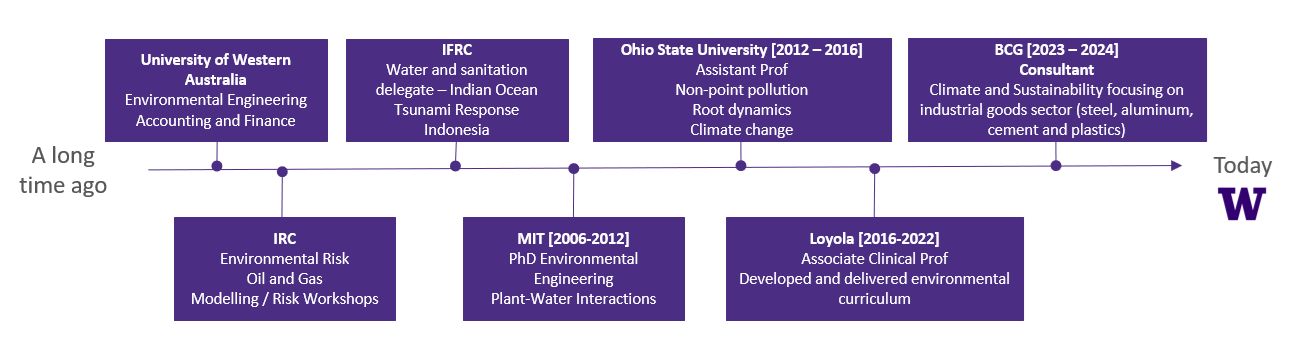
7.1.1 Gaj Sivandran
Teaching Interests
- Design (freshman and senior)
- Fundamental engineering (statics, fluids)
- Environmental labs
- Water resources
Research Interests
- Climate change
- Active learning pedagogy
- Simulation modeling
- Decision support (socio-economic modeling)
Random Facts
- I have an 11yr old daughter that helps me write exam questions
- Dogs >Cats, Cricket > Baseball, AFL > NFL, Vegemite > Peanut butter
- I like to run very very long distances, stilling working on why
7.2 Classroom Etiquette

- Please feel free to bring your breakfast/lunch to class – just be sure to clean up before you leave
- Bring whatever tech you need to take notes and engage. We will be using Poll everywhere
- Ask questions – but please be respectful of all voices and views - wrong answers have more value than right ones!
7.3 Why are you here?
Discussion In small groups:
- Introduce yourselves
- Why are you all here?
- What do you think this class could be useful for?
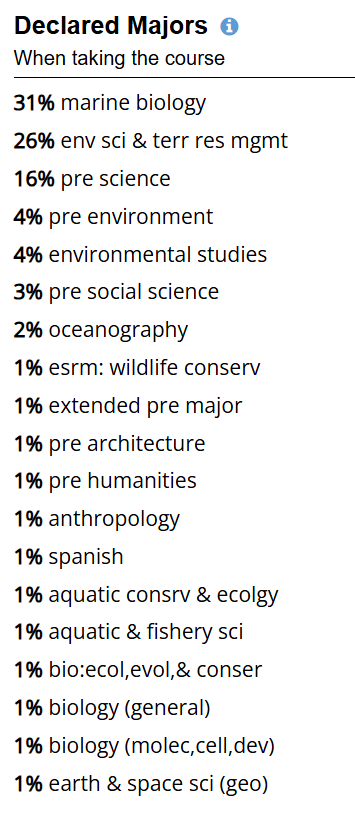
- What do you notice about the declared majors in this class?
Class Make Up
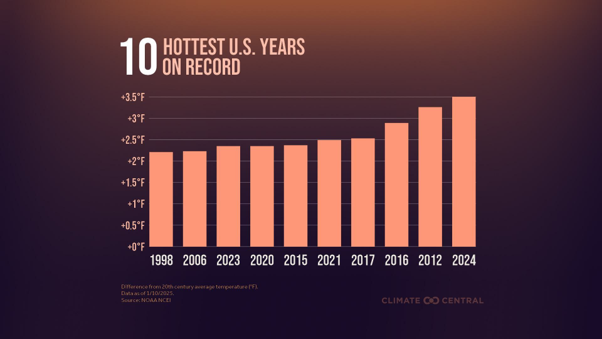
- Freshman 15%
- Sophomores 50%
- Juniors 30%
- Seniors 5%
- Transfer Students 10%

7.5 My Expectations of You

Objective 1 : The ability to apply calculus to the natural system
- Calculus is a language that allows us to tell complex environmental stories
Objective 2: Effort
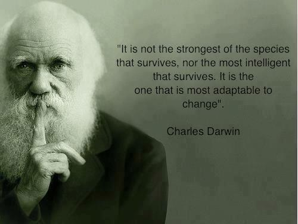
- The best definition of I have come across the struggle to continue against a mounting desire to stop - Alex Hutchinson, Endure
7.6 Your Expectations of Me
Discussion
In a small group make 2 lists
- What can you come to see me about?
- What should you find someone else for?
7.7 Syllabus Highlights
7.7.1 Assessments
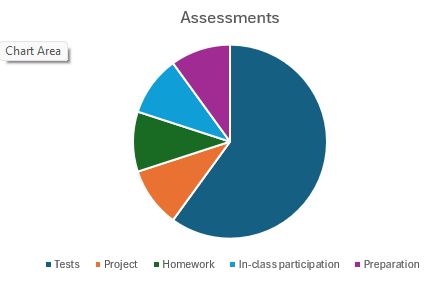
Preparation & Participation [10%]
- Before class readings/questions
- After-class self checks
- In-class activities
- Polleverywhere
Homeworks [10%]
- Roughly every week
- Revise and resubmit
- Grade on accuracy and effort
Tests [70%]
- 4 Tests over the term
- 2 can be re-taken during finals week
- 1 pg of notes (2sides)
Project [10%]
- Low stakes group project applying the big picture concepts of this class
- Focuses on reading and interpreting the math
Class discussion
Why do you think there is so much weight on tests and participation?
7.7.2 Acedemic Integrity
This class has been designed to reward you for doing your own work.
Tests will be relatively straightforward if you make the effort on the in-class and homework assessments
Using these resources will only make studying for tests harder. Many of these resources give you the illusion of understanding - but the reality is quite different.

7.7.4 Late Assessment / Missed Assessment Policy
This is a firm policy to make sure I am being fair to all of you.
Grace period: Homeworks for this class are due Friday at 11:59pm. Homeworks will be accepted 72 hrs after their due date with no penalty (Monday 11:59pm). Graded work not turned in by this time will receive a grade of zero.
Missed Tests: If you miss a test, you will need to use one of your ‘re-takes’ during finals weeks to do it. However, if you have a legitimate reason, I will work with you to reschedule the test earlier so you can save your re-take.
Missed Class Preparation/Participation: From time to time we miss class for several reasons (studying for another test that day, field work, illness, etc). There will be no opportunity to submit preparation and participation activities if they are missed. The purpose of these activities are to reinforce concepts in the moment – and have little value out the context of the material being covered that day.
To accommodate for this, 5% of the total preparation and participation assessments will be dropped. There will also be additional extra-credit opportunities throughout the term.
Exceptional Circumstances: You must contact me 48 hours before the actual due date (not after the 48hr grace period) of a graded assignment to give me advanced notice, or within 12 hours after the work is due in the case of an emergency. If you fail to do this, you will receive zero credit for the missed assignment.
Class Discussion
What do we consider exceptional circumstances?
7.7.5 Test Retakes Policy
There is no Final in this class – BUT – I will use the finals time slot for the retakes. So don’t plan an early break if you think you might be doing a retake.
If you miss a test during the term for a valid reason (health, emergency etc) and inform me in a timely manner, I’ll schedule a time during office hours for you to take the test. This flexibility is only good for a couple of days as I want to get the graded tests back to the rest of the class.
If you miss a test for another reason (slept in, went to a wedding etc) you can always use one of your retakes – that’s what they are for.
Reasons to retake Missed a test Want to try for a better grade Love calculus so much you want to do more problems
You can retake up to 2 tests. Your best score counts – so no risk
7.7.6 Class notes
All notes that I take in class are available on the OneNote notebook link on Canvas All lectures will be recorded - these will also be made available on Canvas
From time to time the technology will fail us. Remember these are being provided as a bonus. There is no substitute for attending class and taking your own notes.
7.8 Questions?
Class discussion
Ask me anything - whats on your mind - need clarification on any of the things we’ve talked about?
7.9 Paper Planes
Paper Plane Activity We are going to make paper planes and then see how well they fly.
We are going to break into 4 groups:
- Group 1: Instructions not included – I know how to make a paper plane already
- Group 2: Notes - Watch the video multiple times, pausing and taking notes – I’m confident I can make a good plane
- Group 3: Team – Work together and make 1 TEAM plane.
- Group 4: Solo first + then team up - Make your own plane, then make a team plane
- Group 5: Reverse Engineer it
Discussion
Why did we make paper planes in calculus?
7.10 Rate of Change - A First Look
Class Discussion
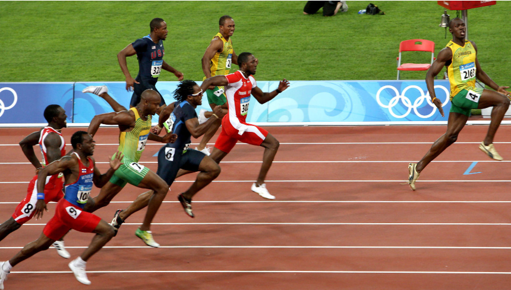
When we try to understand derivatives, the most common place to start is Position->Velocity->Acceleration and how they are linked.
Lets have a look at this while watching Usain Bolt run the 100m in 9.69s
While we watch this video I want you to keep in mind the idea of change - what variables are changing as we move through this race.
Group Discussion
How fast did he run? Can you calculate it?
What was the fastest he ran? OR what was his top speed (velocity)? When do you think this happened?
3)The time it took him to get to 10m markers was measured, and the plot is below. What does this tell us about how fast he ran?
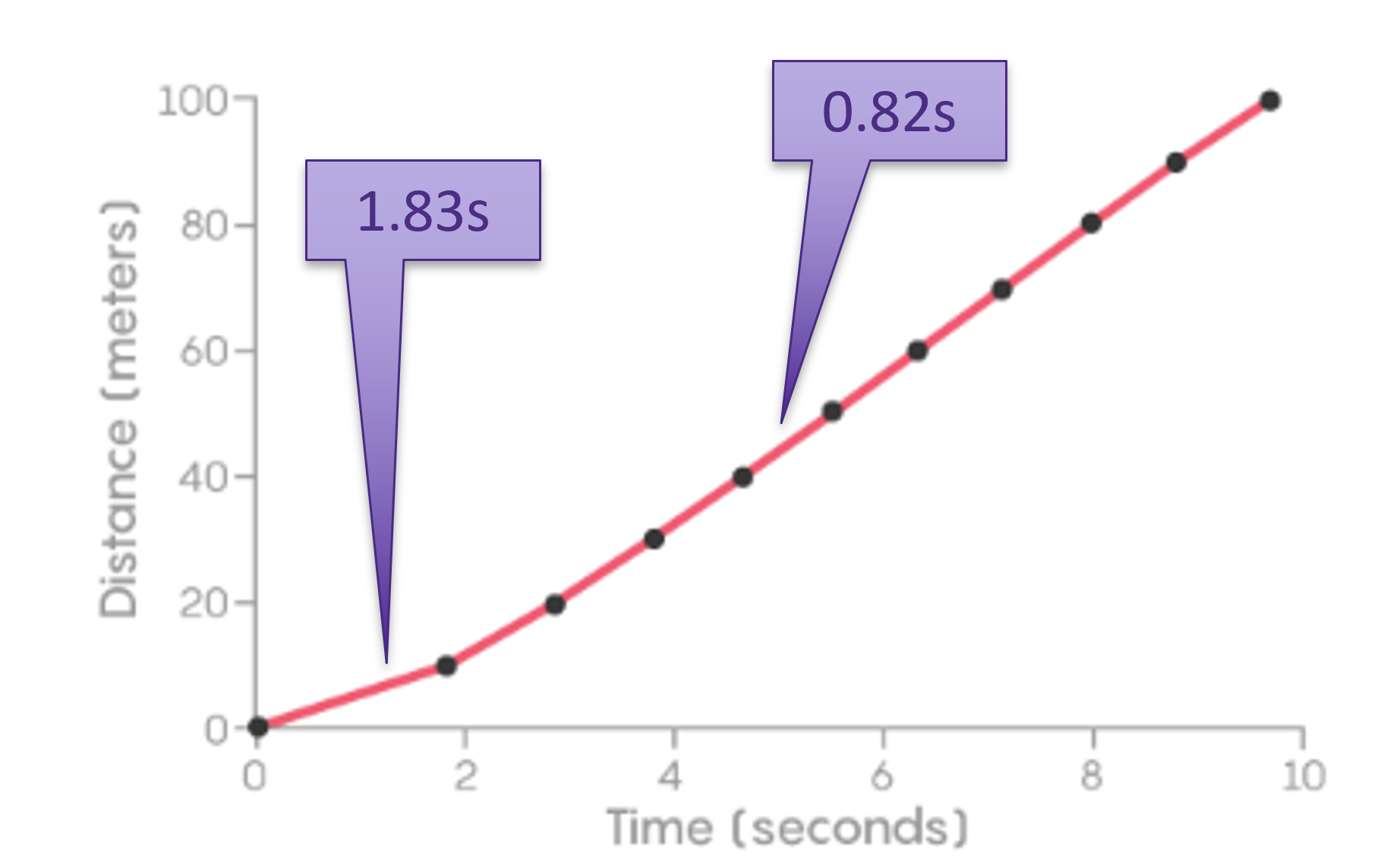
4)If we fit a smooth curve to this path, instead of looking at the slope over every 10m, we can look at the instantaneous rate of change or the derivative at any point.
Note: The reason the curve needs to be smooth will be covered later - this is all just a preview
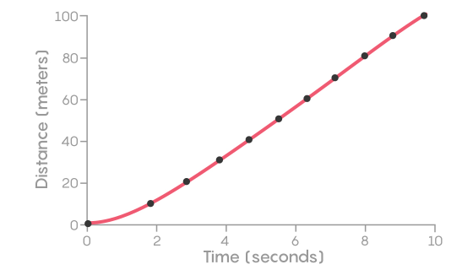
- No if we calculate the instantaneous rate of change and plot it against time - we get the velocity vs time relationship.
Using this - try to describe how is velocity (speed) varied during the race.
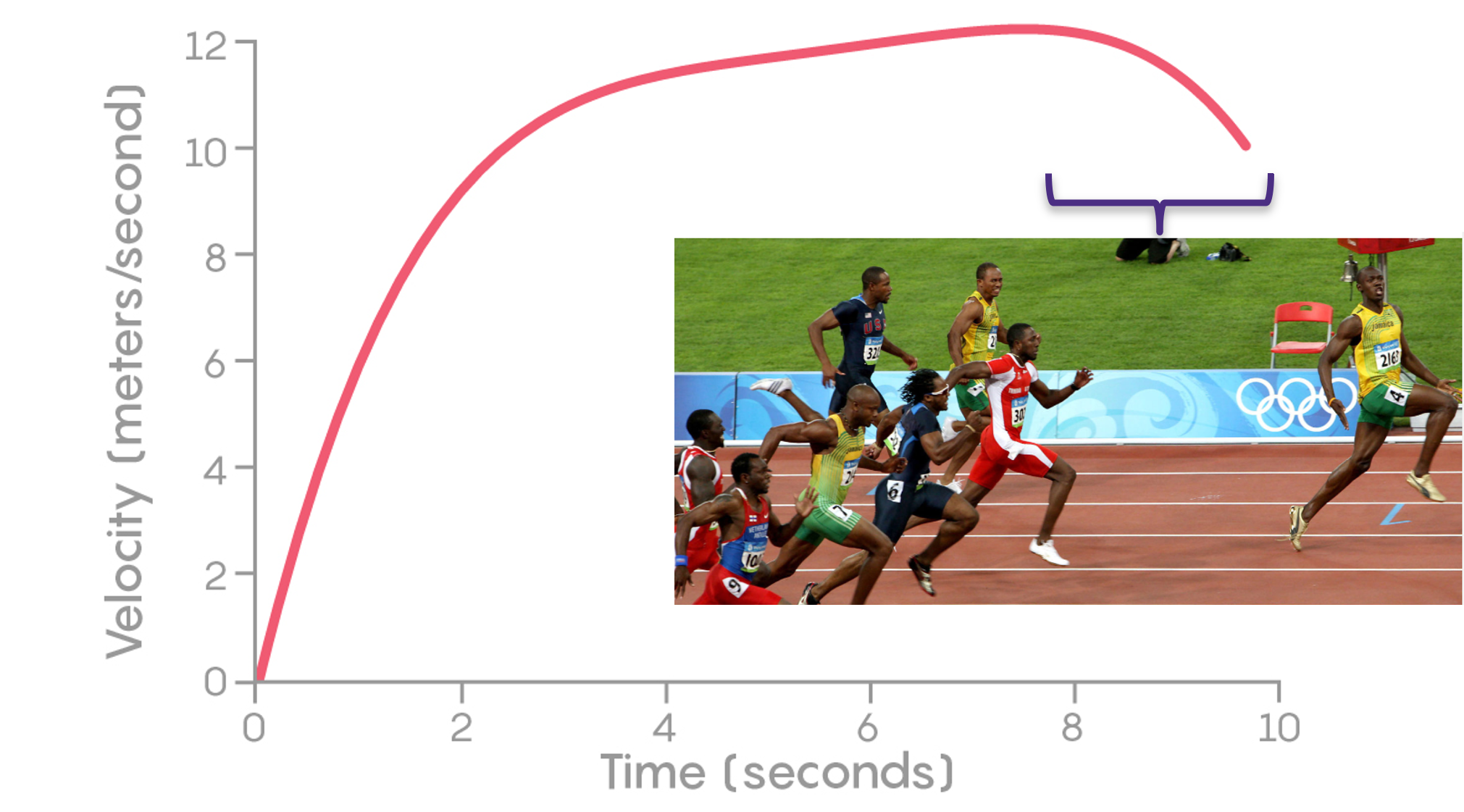
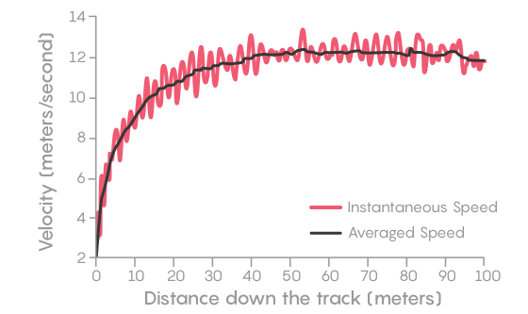
- The world wondered how fast he could actually run the 100m. A year later at the world championships sensors were places along the tract to capture in high resolution his position with time.
- What do you notice this time?
- What is causing the oscillating in the red line?