Test 3 Review Material
Test Instructions
Below are the general instructions for all tests
- You will get a chance to retake this. Your highest score counts toward your final grade.
- Follow the guidance for each part and show all work for full credit.
- Non-graphical calculators are allowed.
- One page (two sides) of handwritten (or font size 8) notes are allowed.
- The equation sheet from the textbook is included as part of the test pack (it doesn’t count as note pages)
Test Format
You should be able to do the following for this test
- Evaluate Signed/NET integrals
- Calculate the average of a function using an integral
- Calculate the total/geometric area between two curves
- Evaluate double integrals
- Evaluate triple integrals
- Be able to explain what the applications above are doing and interpret them
- Short answer / Multiple Test
- Interpret / Sketch
Part A — Short Answer (Concepts)
There will not be a short answer section - but there might be short answer interpretations at the end of calculations.
1. What does a definite integral represent?
Hint
Think about accumulation. What are we adding up? What does the sign of the function matter?
Suggested Answer
A definite integral represents the net accumulation of a quantity over an interval. Geometrically, it is the signed area between the curve and the \(x\)-axis from \(a\) to \(b\).
2. Difference between signed integral and total accumulation?
Hint
What happens when the function is below the \(x\)-axis? Does it subtract or still add?
Suggested Answer
A signed integral allows areas below the axis to subtract from areas above. Total accumulation uses absolute value so all contributions are counted positively.
3. Why do we use absolute value for geometric area?
Hint
Area is always positive in geometry.
Suggested Answer
Because geometric area measures size, not direction, and must always be positive, we use absolute value to prevent cancellation.
4. What must be true about top minus bottom?
Hint
What ensures the integrand stays positive?
Suggested Answer
The function labeled “top” must be greater than or equal to the bottom function across the entire interval.
5. What goes wrong if curves cross and you don’t split?
Hint
Think about sign changes in \(f(x)-g(x)\).
Suggested Answer
If the curves cross, the integrand changes sign, leading to cancellation and an incorrect area value.
6. Why find intersection points?
Hint
What happens at those points?
Suggested Answer
Intersection points mark where the top and bottom functions switch roles, allowing us to correctly split the integral.
7. How do we split if they intersect at \(x=c\)?
Hint
Write two integrals.
Suggested Answer
\[ \text{Area} = \int_a^c (f-g)\,dx + \int_c^b (g-f)\,dx \]
8. How can you quickly determine which function is on top?
Hint
Test a value in the interval.
Suggested Answer
Evaluate both functions at a convenient test point within the interval and compare their values.
9. What does average value mean conceptually?
Hint
Imagine flattening the function into a constant height.
Suggested Answer
The average value is the constant height that would produce the same total area over the interval.
10. Why divide by \(b-a\)?
Hint
Think “total divided by length.”
Suggested Answer
We divide by the interval length to convert total accumulation into a per-unit average.
11. Geometric interpretation of average value?
Hint
Picture a rectangle.
Suggested Answer
It is the height of a rectangle with base \(b-a\) that has the same area as the region under \(f(x)\).
12. What does \(dA\) represent?
Hint
Tiny what?
Suggested Answer
\(dA\) represents a tiny piece of area, typically a small rectangle in the plane.
13. What does a double integral do that a single integral cannot?
Hint
Think dimension.
Suggested Answer
A double integral accumulates values over a two-dimensional region, not just along a line.
14. Why treat outer variable as constant?
Hint
Integration rules.
Suggested Answer
Because when integrating with respect to one variable, all other variables are treated as constants by definition of partial integration.
15. What does \(dV\) represent?
Hint
Tiny 3D piece.
Suggested Answer
\(dV\) represents a tiny volume element, such as a small rectangular box.
Part B — Signed Integrals
1. Compute
\[ \int_{-2}^{4} (2x-5)\,dx. \]
Hint
Find an antiderivative \(F(x)\) and evaluate \(F(4)-F(-2)\).
Worked Solution
\[ \int (2x-5)\,dx=x^2-5x \]
\[ \left[x^2-5x\right]_{-2}^{4} =(16-20)-\left(4+10\right) =-4-14=-18 \]
\[ \boxed{-18} \]
2. Compute
\[ \int_{1}^{e} \frac{1}{x}\,dx. \]
Hint
What is the antiderivative of \(1/x\)?
Worked Solution
\[ \int \frac{1}{x}\,dx=\ln x \]
\[ \left[\ln x\right]_{1}^{e}=1-0=1 \]
\[ \boxed{1} \]
Part C — Average Value
5. Find the average value of
\[
f(x)=x^2+4x
\]
on \([-1,2]\).
Hint
Use \(f_{\text{avg}}=\frac{1}{b-a}\int_a^b f(x)\,dx\).
Worked Solution
\[ f_{\text{avg}}=\frac{1}{3}\int_{-1}^{2}(x^2+4x)\,dx \]
\[ \int (x^2+4x)\,dx=\frac{x^3}{3}+2x^2 \]
Integral value \(=9\).
\[ f_{\text{avg}}=\frac{9}{3}=3 \]
\[ \boxed{3} \]
Part D — Area Between Curves
7. Find the area between
\[
f(x)=2x+1
\quad\text{and}\quad
g(x)=x^2
\]
on \([0,2]\).
Hint
Determine which function is on top.
Worked Solution
Since \(2x+1 > x^2\) on \([0,2]\),
\[ \text{Area}=\int_0^2((2x+1)-x^2)\,dx \]
\[ \int(-x^2+2x+1)\,dx=-\frac{x^3}{3}+x^2+x \]
\[ \left[-\frac{x^3}{3}+x^2+x\right]_0^2 =-\frac{8}{3}+4+2=\frac{10}{3} \]
\[ \boxed{\frac{10}{3}} \]
8. Find the total area between
\[ f(x)=x^2-1 \quad\text{and}\quad g(x)=0 \] on \([-2,2]\).
Hint
Find where \(x^2-1=0\). Split the integral and use symmetry.
Worked Solution
Zeros at \(x=\pm1\).
\[ \text{Area}=\int_{-2}^{2}|x^2-1|\,dx =2\left(\int_0^1(1-x^2)\,dx+\int_1^2(x^2-1)\,dx\right) \]
\[ \int_0^1(1-x^2)\,dx=\frac{2}{3}, \quad \int_1^2(x^2-1)\,dx=\frac{4}{3} \]
\[ 2\left(\frac{2}{3}+\frac{4}{3}\right)=4 \]
\[ \boxed{4} \]
9. Find the area between
\[ f(x)=e^x \quad\text{and}\quad g(x)=x+1 \] on \([0,1]\).
Hint
Check where they intersect and determine which is on top.
Worked Solution
They meet at \(x=0\). For \(x>0\), \(e^x > x+1\).
\[ \text{Area}=\int_0^1\left(e^x-(x+1)\right)\,dx \]
\[ =e^x-\frac{x^2}{2}-x\Big|_0^1 =\left(e-\frac12-1\right)-1 =e-\frac{5}{2} \]
\[ \boxed{e-\frac{5}{2}} \]
Part E — Double Integrals
10. Evaluate
\[ \int_{0}^{1}\int_{-1}^{2}(3x-y)\,dy\,dx. \]
Hint
Do the inner integral first.
Worked Solution
\[ \int_{-1}^{2}(3x-y)\,dy =\left[3xy-\frac{y^2}{2}\right]_{-1}^{2} =9x-\frac{3}{2} \]
\[ \int_0^1\left(9x-\frac{3}{2}\right)\,dx =3 \]
\[ \boxed{3} \]
Part F — Triple Integrals
13. Evaluate
\[ \int_{0}^{1} \int_{0}^{1} \int_{0}^{2} (2x+y+z)\,dz\,dy\,dx. \]
Hint
Integrate in order: \(z\), then \(y\), then \(x\).
Worked Solution
After integrating step-by-step:
\[ \boxed{5} \]
Review Sheet: Evaluating Definite Integrals (Net / Signed Accumulation)
What Is a Definite Integral — and Why Do We Care?
A definite integral
\[ \int_a^b f(x)\,dx \]
measures net accumulation.
It answers:
- How much total change occurred?
- How much accumulated over time or space?
- What is the net effect of gains and losses?
The key idea:
A definite integral does not measure geometric area unless the function is always positive.
It measures signed area.
Positive values add.
Negative values subtract.
Big Idea: The Fundamental Theorem of Calculus
If \(F'(x) = f(x)\), then
\[ \int_a^b f(x)\,dx = F(b) - F(a) \]
So evaluating a definite integral means:
- Find an antiderivative.
- Apply bounds (evaluate at top minus bottom).
- Simplify.
Always subtract:
\[ F(b) - F(a) \]
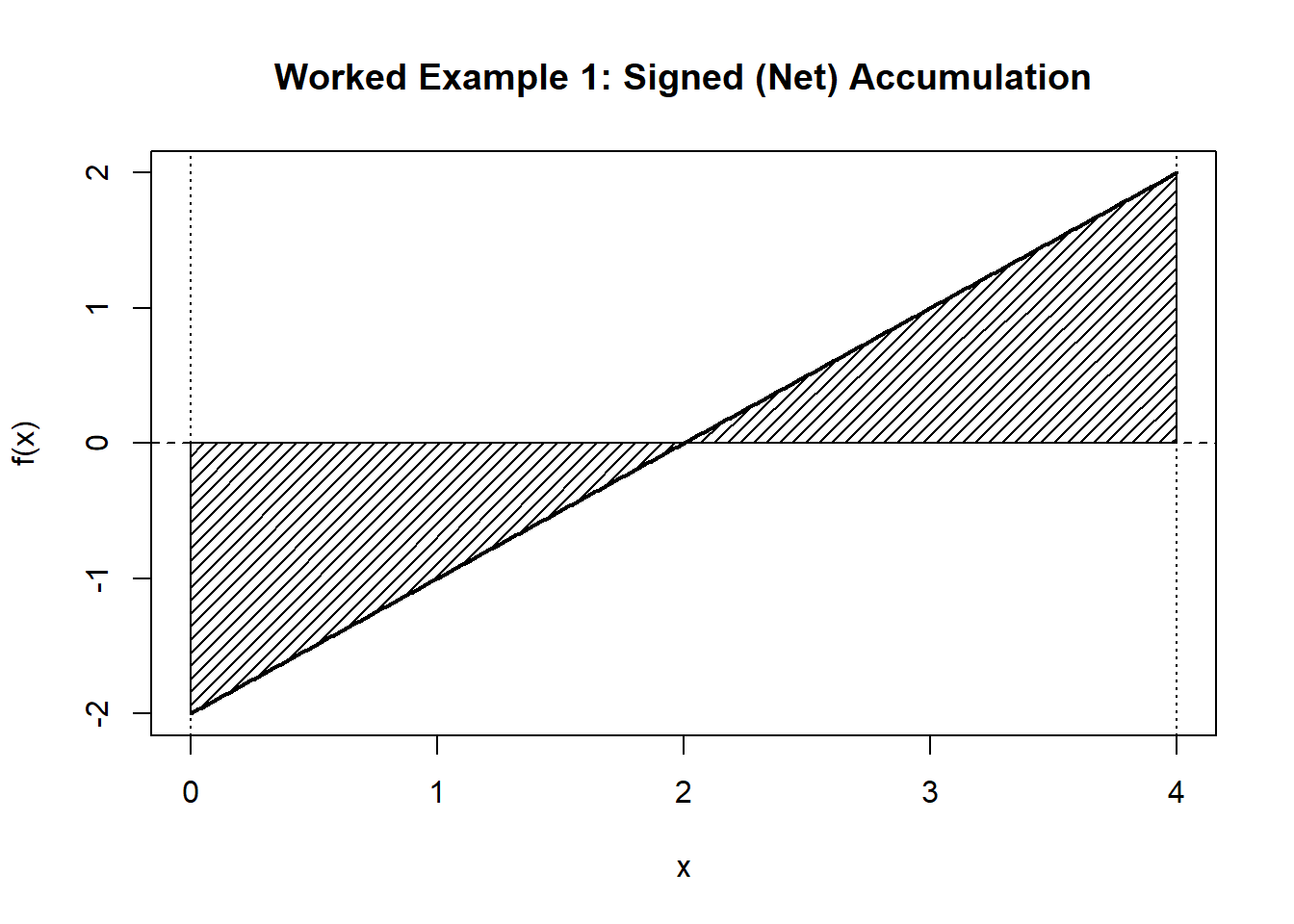
Worked Example 1
\[ \int_0^4 (x - 2)\,dx \]
Step 1: Antiderivative
\[ \int (x-2)\,dx=\frac{x^2}{2}-2x \]
Step 2: Apply the bounds
\[ \left[\frac{x^2}{2}-2x\right]_0^4 \]
Step 3: Plug in the top bound \(x=4\)
\[ \frac{4^2}{2}-2(4)=\frac{16}{2}-8=8-8=0 \]
Step 4: Plug in the bottom bound \(x=0\)
\[ \frac{0^2}{2}-2(0)=0 \]
Step 5: Subtract (top minus bottom)
\[ 0-0=0 \]
\[ \boxed{0} \]
✔ Net accumulation: 0
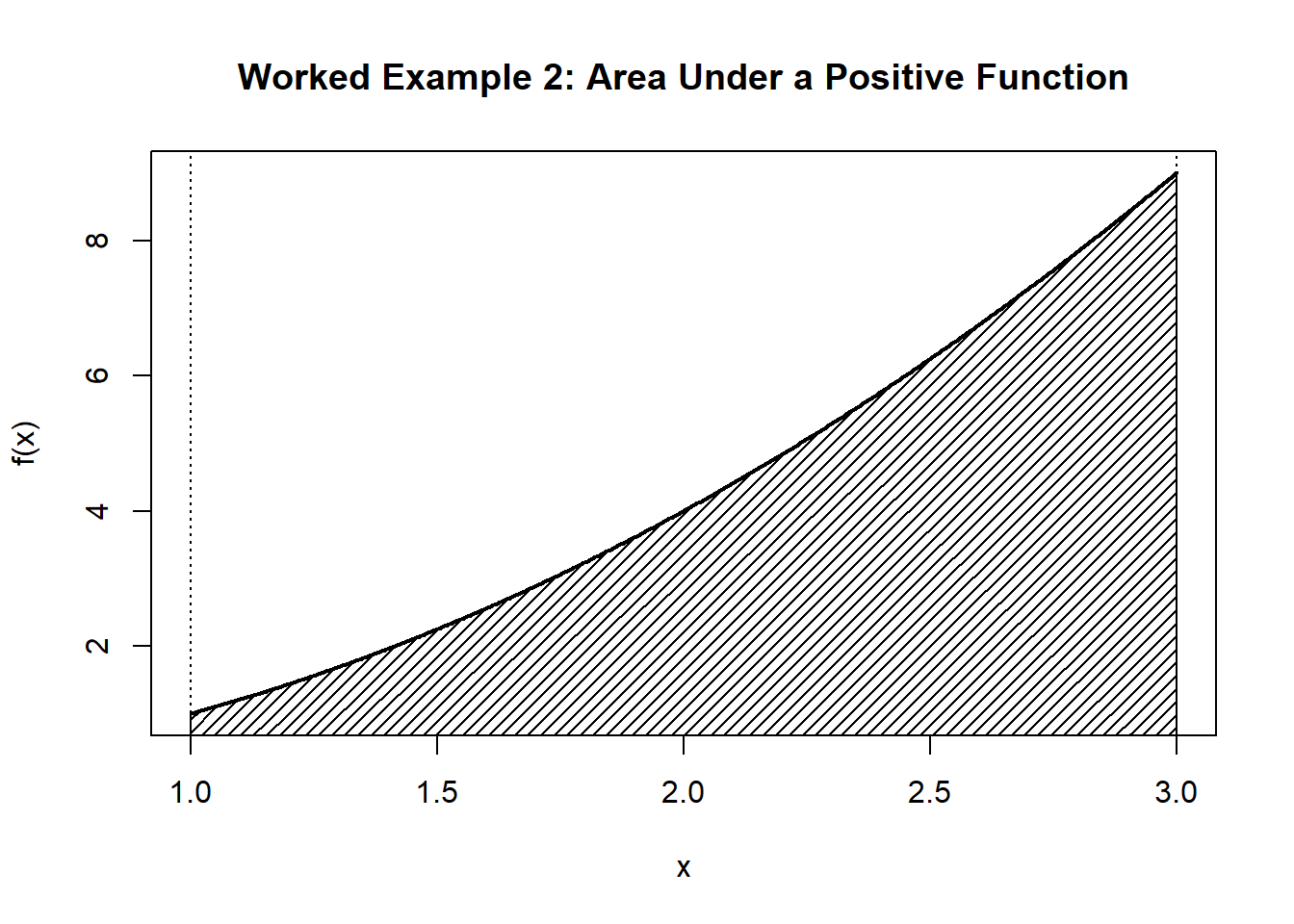
Worked Example 2 (Always Positive Function)
\[ \int_1^3 x^2\,dx \]
Step 1: Antiderivative
\[ \int x^2\,dx=\frac{x^3}{3} \]
Step 2: Apply the bounds
\[ \left[\frac{x^3}{3}\right]_1^3 \]
Step 3: Plug in the top bound \(x=3\)
\[ \frac{3^3}{3}=\frac{27}{3}=9 \]
Step 4: Plug in the bottom bound \(x=1\)
\[ \frac{1^3}{3}=\frac{1}{3} \]
Step 5: Subtract (top minus bottom)
\[ 9-\frac{1}{3}=\frac{27}{3}-\frac{1}{3}=\frac{26}{3} \]
\[ \boxed{\frac{26}{3}} \]
✔ Net accumulation (and total area): \(\displaystyle \frac{26}{3}\)
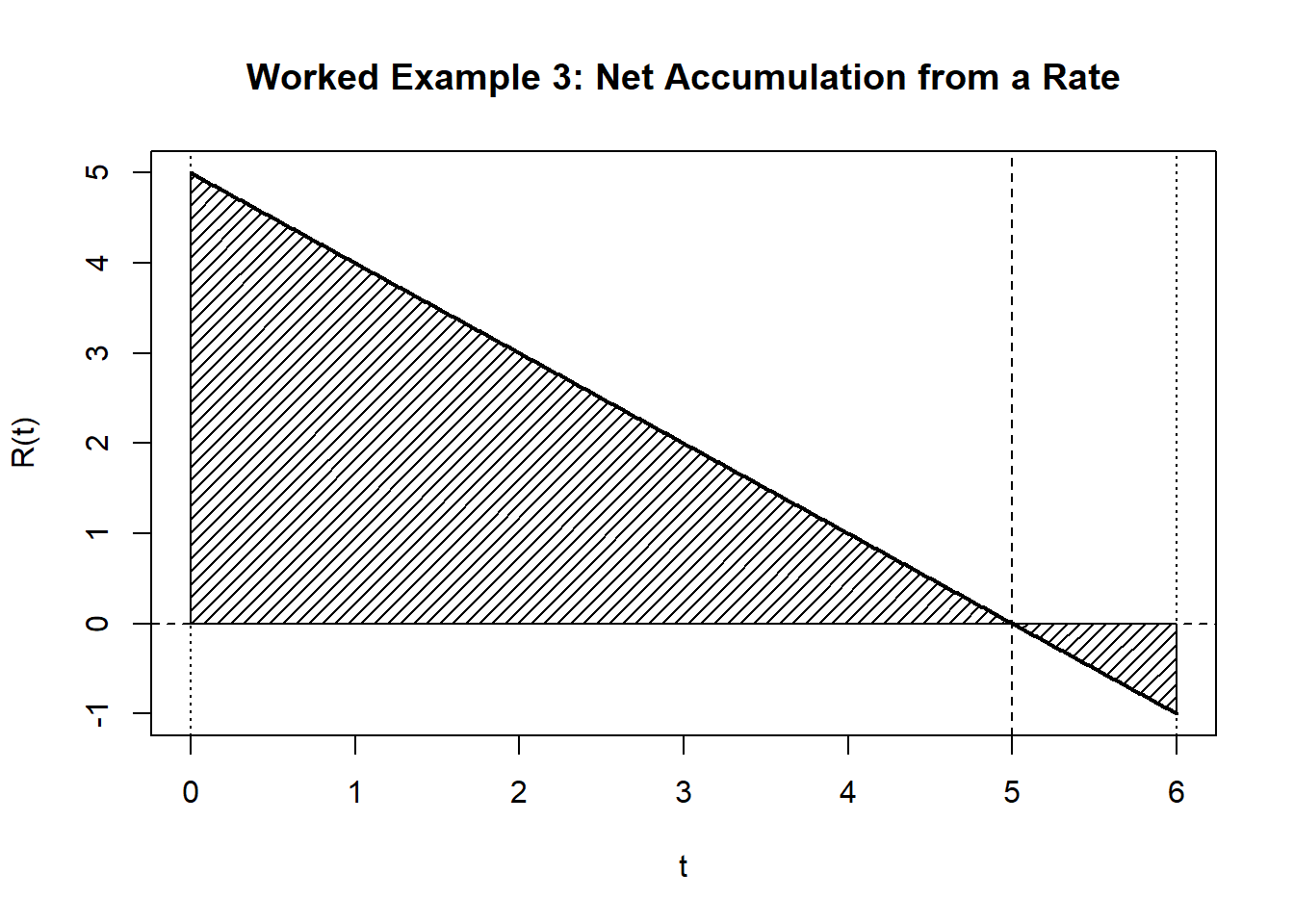
Worked Example 3 (Rate Interpretation)
Suppose \(R(t)=5-t\) is a rate. Find total change from \(t=0\) to \(t=6\):
\[ \int_0^6 (5-t)\,dt \]
Step 1: Antiderivative
\[ \int (5-t)\,dt = 5t-\frac{t^2}{2} \]
Step 2: Apply the bounds
\[ \left[5t-\frac{t^2}{2}\right]_0^6 \]
Step 3: Plug in the top bound \(t=6\)
\[ 5(6)-\frac{6^2}{2}=30-\frac{36}{2}=30-18=12 \]
Step 4: Plug in the bottom bound \(t=0\)
\[ 5(0)-\frac{0^2}{2}=0 \]
Step 5: Subtract (top minus bottom)
\[ 12-0=12 \]
\[ \boxed{12} \]
✔ Total change: 12
Practice Problems
Part A — Compute the Net Accumulation
\[ \int_0^5 (x - 3)\,dx \]
\[ \int_1^4 (2x)\,dx \]
\[ \int_0^2 (4 - x^2)\,dx \]
\[ \int_0^3 (x^2 - 4)\,dx \]
Part B — Think Carefully
If a function is below the x-axis on an interval, is the definite integral positive or negative? Why?
What is the difference between:
- total geometric area
- net (signed) accumulation
- total geometric area
If \(\displaystyle \int_2^6 f(x)\,dx=-8\), what does that tell you about the function’s overall behavior on that interval?
Answer Key
Part A Solutions
1. \(\displaystyle -\frac{5}{2}\)
2. \(\displaystyle 15\)
3. \(\displaystyle \frac{16}{3}\)
4. \(\displaystyle -3\)
Part B Solutions
5. Negative, because signed area below the axis subtracts from net accumulation.
6. Total area ignores sign; net accumulation keeps sign and represents overall change.
7. Net accumulation is negative; values below the axis dominate overall.
Review Sheet: Area Between Two Curves (Total / Geometric Area)
What Does “Area Between Curves” Mean — and Why Do We Care?
When we compute area between curves, we are finding geometric area — the size of a region in the plane.
Geometric area is always positive.
That means:
We do not allow parts of the region to cancel out.
Unlike signed integrals, it does not matter whether the curves are above or below the x-axis. The axis is irrelevant. What matters is how the two functions relate to each other — specifically, the vertical distance between them. We are measuring the thickness of the region from the top curve down to the bottom curve, wherever that region sits.
This comes up constantly in applications:
- Total difference between two competing growth rates
- Total “advantage” of one strategy over another
- Total deviation of a measured signal from a baseline
- Total habitat area between two boundary curves
Big Idea
If you integrate top minus bottom over an interval, you get:
- Area, only if the top curve stays on top the whole time.
- Net signed area, if the curves switch order and you don’t split.
So the key skill is knowing when to split and how to set the correct bounds.
Step-by-Step Checklist
- Sketch or compare the functions (even a rough sketch helps).
- Find intersection points (solve \(f(x)=g(x)\)).
- Use those intersection points to define interior bounds.
- On each sub-interval, determine which curve is top and which is bottom.
- Compute area using one of these safe methods:
- Method A: split into pieces where the top curve stays on top
- Method B: integrate \(|f-g|\) by taking absolute value piece-by-piece
- Method A: split into pieces where the top curve stays on top
Technique 1: “Top Function − Bottom Function” (Split at Intersections)
If \(f\) and \(g\) cross at \(x=c\), then you must split:
\[ \text{Area}=\int_a^c \big(\text{top}-\text{bottom}\big)\,dx +\int_c^b \big(\text{top}-\text{bottom}\big)\,dx \]
But the “top” might switch after \(c\).
A quick way to determine the top function on an interval:
- Pick a test point \(x^*\) in the interval and compare \(f(x^*)\) and \(g(x^*)\).
Technique 2: Absolute Value Piece-by-Piece
A very safe method is:
\[ \text{Area}=\int_a^b |f(x)-g(x)|\,dx \]
But do not treat \(|f-g|\) as one algebraic expression unless you know where it changes sign.
In practice, this becomes:
\[ \text{Area} = \int_a^c |f-g|\,dx+\int_c^b |f-g|\,dx \]
On each piece, \(|f-g|\) becomes either \((f-g)\) or \((g-f)\).
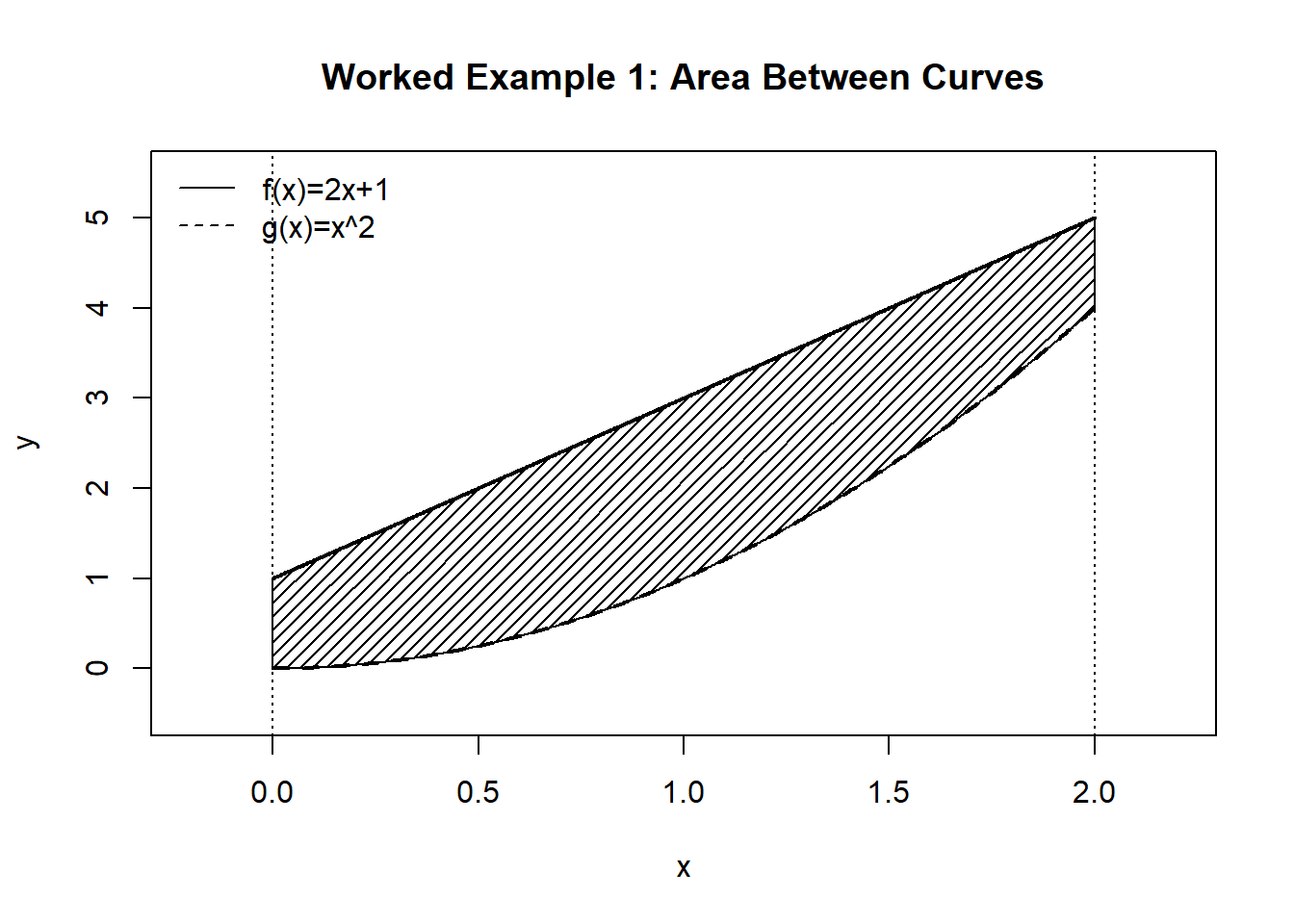
Worked Example 1: Curves Do Not Cross Inside the Interval
Find the total area between:
\[ f(x)=2x+1 \qquad g(x)=x^2 \]
on \([0,2]\).
Step 1: Find intersection points
Solve:
\[ 2x+1=x^2 \Rightarrow x^2-2x-1=0 \]
\[ x=1\pm \sqrt{2} \]
Neither solution lies in \([0,2]\), so there are no interior crossings.
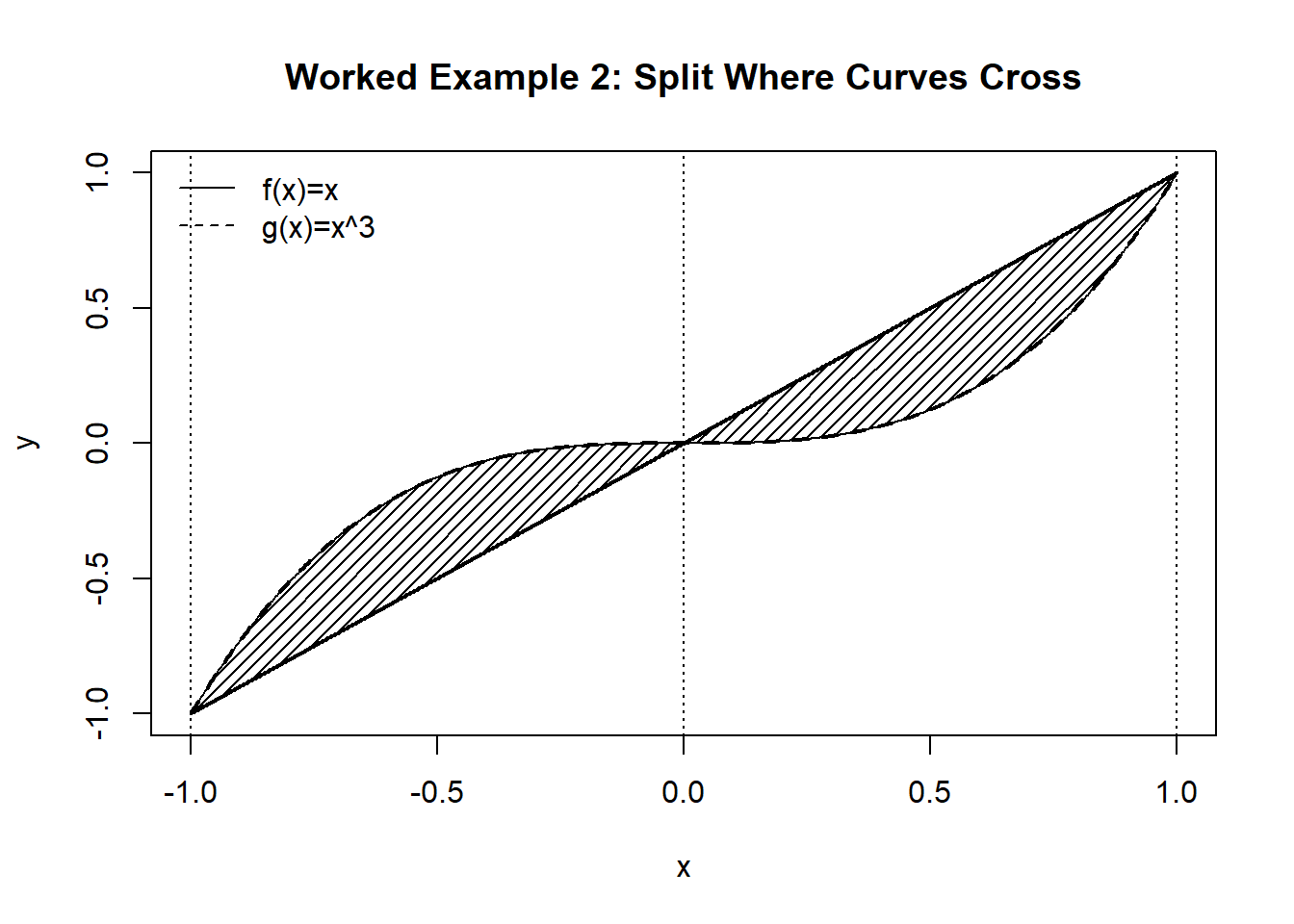
Worked Example 2: Curves Cross Inside the Interval (Must Split)
Find the total area between:
\[ f(x)=x \qquad g(x)=x^3 \]
on \([-1,1]\).
Step 1: Find intersection points (interior bounds)
Solve:
\[ x=x^3 \Rightarrow x(x^2-1)=0 \Rightarrow x=-1,0,1 \]
So split at:
\[ x=-1,\;0,\;1 \]
Step 2: Determine top function on each piece
- On \([-1,0]\): test \(x=-0.5\)
\[ f(-0.5)=-0.5,\quad g(-0.5)=-0.125 \Rightarrow g \text{ is on top} \]
- On \([0,1]\): test \(x=0.5\)
\[ f(0.5)=0.5,\quad g(0.5)=0.125 \Rightarrow f \text{ is on top} \]
Method A: Split and Use Top − Bottom
\[ \text{Area} = \int_{-1}^{0} (x^3-x)\,dx + \int_{0}^{1} (x-x^3)\,dx \]
Antiderivative:
\[ \int (x-x^3)\,dx=\frac{x^2}{2}-\frac{x^4}{4} \]
First piece:
\[ \left[\frac{x^4}{4}-\frac{x^2}{2}\right]_{-1}^{0} \]
Second piece:
\[ \left[\frac{x^2}{2}-\frac{x^4}{4}\right]_{0}^{1} \]
Each evaluates to \(\frac14\).
Total area:
\[ \frac14+\frac14=\frac12 \]
\[ \boxed{\frac12} \]
Method B: Absolute Value Piece-by-Piece
\[ \text{Area}=\int_{-1}^{1} |x-x^3|\,dx \]
Split where sign changes:
\[ = \int_{-1}^{0} |x-x^3|\,dx + \int_{0}^{1} |x-x^3|\,dx \]
On \([-1,0]\), \(x-x^3\le0\), so:
\[ |x-x^3|=x^3-x \]
On \([0,1]\), \(x-x^3\ge0\), so:
\[ |x-x^3|=x-x^3 \]
This produces the exact same two integrals as Method A.
Review Sheet: Double and Triple Integrals
What Do Double and Triple Integrals Represent — and Why Do We Care?
A single integral accumulates along a line.
A double integral accumulates over a region in the plane.
A triple integral accumulates throughout a volume in space.
The idea is the same as with single integrals:
We are adding up tiny pieces.
But now the tiny pieces are not just little line segments — they are:
- Tiny rectangles (area elements)
- Tiny boxes (volume elements)
Double Integrals — Big Idea
A double integral
\[ \iint_R f(x,y)\, dA \]
means:
- Break region \(R\) into tiny rectangles \(dA\).
- Evaluate the function at each small rectangle.
- Add everything together.
If \(f(x,y)=1\), then the double integral simply gives area of the region.
If \(f(x,y)\) is a density, it gives total mass.
If \(f(x,y)\) is height, it gives volume under a surface.
How to Evaluate a Double Integral
Most problems are written as iterated integrals:
\[ \int_a^b \int_{c(x)}^{d(x)} f(x,y)\,dy\,dx \]
This means:
- Integrate the inner integral first (with respect to \(y\)).
- Treat the outer variable \(x\) as constant.
- Then integrate the result with respect to \(x\).
Important:
- The inner bounds belong to the inner variable.
- The outer bounds belong to the outer variable.
Worked Example 1 (Rectangular Region)
Evaluate:
\[ \int_0^2 \int_0^1 (3x + 2y)\,dy\,dx \]
Step 1: Integrate with respect to \(y\)
Treat \(x\) as constant.
\[ \int (3x + 2y)\,dy = 3xy + y^2 \]
Apply bounds:
\[ \left[3xy + y^2\right]_0^1 \]
Top bound \(y=1\):
\[ 3x(1) + 1^2 = 3x + 1 \]
Bottom bound \(y=0\):
\[ 0 \]
So the inner integral becomes:
\[ 3x + 1 \]
Triple Integrals — Big Idea
A triple integral
\[ \iiint_E f(x,y,z)\, dV \]
means:
- Break a 3D region into tiny boxes \(dV\).
- Evaluate the function at each box.
- Add them all together.
If \(f(x,y,z)=1\), the result is volume.
If \(f\) is density, the result is total mass.
How to Evaluate a Triple Integral
Typical form:
\[ \int_a^b \int_{c(x)}^{d(x)} \int_{e(x,y)}^{f(x,y)} f(x,y,z)\,dz\,dy\,dx \]
You integrate:
- Inside first.
- Work outward step-by-step.
- Treat outer variables as constants each time.
Worked Example 2 (Rectangular Box)
Evaluate:
\[ \int_0^1 \int_0^1 \int_0^2 (2x + y + z) \,dz\,dy\,dx \]
Step 1: Integrate with respect to \(z\)
Treat \(x\) and \(y\) as constants.
\[ \int (2x + y + z)\,dz = (2x + y)z + \frac{z^2}{2} \]
Apply bounds:
\[ \left[(2x + y)z + \frac{z^2}{2}\right]_0^2 \]
Top bound \(z=2\):
\[ 2(2x + y) + 2 = 4x + 2y + 2 \]
Bottom bound \(z=0\):
\[ 0 \]
So the expression becomes:
\[ 4x + 2y + 2 \]
Conceptual Reminders
- A double integral adds over area.
- A triple integral adds over volume.
- Order of integration can change, but the total remains the same if the region is unchanged.
- Always match bounds to the variable being integrated.
- Always treat outer variables as constants when integrating inside.
Practice Problems
Evaluate: \[ \int_0^1 \int_0^2 (x + y)\,dy\,dx \]
Evaluate: \[ \int_0^1 \int_0^1 \int_0^1 xyz\,dz\,dy\,dx \]
Evaluate: \[ \int_{0}^{1}\int_{0}^{1-x}\int_{0}^{1-x-y} (x+2y+3z)\,dz\,dy\,dx \]
What does a double integral compute if \(f(x,y)=1\)?
What does a triple integral compute if \(f(x,y,z)=\rho(x,y,z)\)?
Answer Key
1.
Inner: \(xy + \frac{y^2}{2}\big|_0^2 = 2x + 2\)
Outer: \(\int_0^1 (2x+2)\,dx = 3\)
2.
Separate variables:
\[
\frac18
\]
3. \[ \int_{0}^{1}\int_{0}^{1-x}\int_{0}^{1-x-y} (x+2y+3z)\,dz\,dy\,dx = \frac{1}{4} \]
4. Area of the region.
5. Total mass (density integrated over volume).